
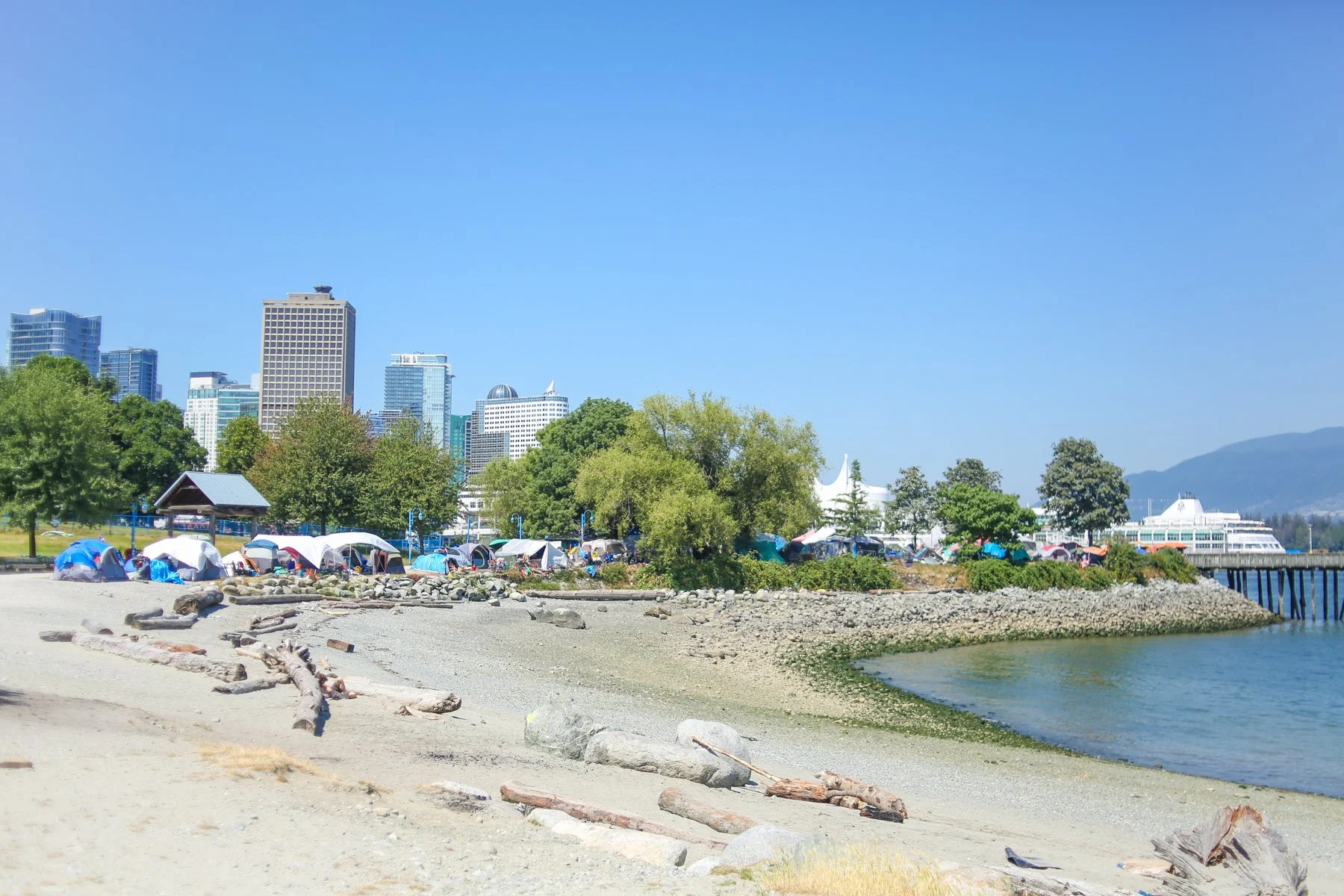
Photo by Christopher Cheung for The Tyee, 2022. Republished with permission
The Bylaw State and the Crisis of Housing in Canada
Courts across the country have struck down city bylaws which prevent people from sheltering in parks. Despite this, municipal governments continually weaponize bylaws, contravening the rights of unhoused individuals.
By Alexandra Flynn
CRAB Park abuts Vancouver’s downtown waterfront, on unceded Squamish, Musqueam, and Tsleil-Waututh lands that the federal government owns and the city’s park board governs through its bylaws. Through the pandemic it became a refuge for those with nowhere else to go. In 2022, its residents won what looked like a decisive victory: the British Columbia Supreme Court, in Bamberger v. Vancouver (Board of Parks and Recreation), held that the park board had violated their rights by ordering them to stop camping in the park. While this victory protected them from displacement, the bylaws were later amended and, over time, the park board chipped away at protections until all residents were removed. This example, and so many others across Canada, highlight the gap between hard-won constitutional protections and seemingly mundane municipal bylaws.
More than a supply problem
Canada’s alarming increase in homelessness is not simply a story about a shortage of homes, though inadequate supply and weak tenancy protections are certainly part of it. At its core, the crisis is about affordability, income levels, and the absence of an enforceable right to housing.
As of 2024, approximately 2.4 million households in Canada are in core housing need (which is when housing costs more than 30 per cent – and usually much higher – of a household’s pre-tax income with no other suitable affordable options available). Even middle-class families struggle to find something they can afford, and for those on lower incomes the situation is dire: there simply are not enough affordable and deeply affordable homes. Weak tenancy protections allow landlords to raise rents between tenancies and to evict even where tenants have complied with their obligations. Many people, including those on social assistance, experience discrimination. Wages have not kept pace with the cost of living, and the rise of precarious employment means more people are one missed paycheque away from losing their homes. When a crisis arrives, like a job loss, an illness, domestic violence, or drug dependency, there is often little to nothing in the way of a safety net to catch a person before their options run out.
Compounding the issue is the absence of a legal framework for housing. Despite years of promises from governments, housing is not currently recognized as an enforceable, legally protected right, even with important legal instruments in place. In 2019, the federal government enacted the National Housing Strategy Act which recognizes the right to adequate housing as a fundamental human right affirmed in international law. Canada also has the Charter of Rights and Freedoms that guarantees protections including for life, liberty, and security of the person. Even so, governments resist adopting a human rights approach to housing. Instead, we have a scattered mix of policies and little intergovernmental co-operation, with each of the federal, provincial, and municipal governments pointing their fingers at the others as primarily responsible.
The Sharp End of the Crisis
Homelessness is the most glaring result of the lack of affordable housing and of policy failure at every level of government. It has taken decades to get to this point. Homelessness is connected to the federal government’s disinvestment in social housing, the financialization of housing, and precarious labour. As federal and provincial governments withdrew from housing and related supports, municipalities came to play an outsized role in managing the crisis, largely through policing and bylaws.
The data, though imperfect, communicates the gravity of the situation. In 2024, national point-in-time counts identified close to 60,000 people across 74 communities as experiencing homelessness on a single night, including more than 17,000 in unsheltered locations such as encampments. Of all groups, the unsheltered population is growing fastest; there was a 303 per cent increase from 2018 to 2024.
There are not enough available or adequate indoor shelter spaces. As the British Columbia Supreme Court observed in the 2022 Bamberger decision, those sheltering in a park overwhelmingly stated that they would prefer to be indoors, but that the available shelters were unsuitable. Shelters routinely impose curfews, refuse pets and partners, deny storage for belongings, and enforce zero-tolerance drug policies. For survivors of abuse, for couples, and for people with complex needs, the shelter bed is frequently not a real option at all. The mere presence of a bed does not amount to adequate or accessible housing.
The homelessness crisis is especially acute for already vulnerable populations. People identifying as Indigenous are dramatically overrepresented: more than two-thirds of unhoused people in Prince George identify as Indigenous. In Greater Vancouver, roughly 34 per cent identify as Indigenous, despite making up only approximately 2 per cent of the city’s population. As Métis-Cree author and York University assistant professor of humanities Jesse Thistle reminds us, Indigenous homelessness cannot be understood through the narrow colonial lens of whether a person has indoor shelter; rather, the direct result of it is disconnection from land, culture, language, and community, and from the chronic underfunding of Indigenous communities by every order of government. Thistle writes, “Indigenous worldviews conceptualize home more deeply as a web of relationships and responsibilities involving connections to human kinship networks; relationships with animals, plants, spirits and elements; relationships with the Earth, lands, waters and territories; and connection to traditional stories, songs, teachings, names and ancestors.” Women and 2SLGBTQIA+ people are likewise more likely to live in poverty.
Governing by Bylaw
Cities are, legally speaking, unusual entities. They are responsible for local services and public spaces but, unlike provincial and federal governments, they are not constitutionally recognized, and they exercise little real control over housing policy. Despite the fact that homelessness is a humanitarian crisis, municipalities often reach for a powerful instrument to manage it: the bylaw.
Bylaws were never intended for this work. They were meant to address noise, loitering, parking, and park maintenance. They are meant to be neutral in their application and to apply to places, not people.
With shelters full and housing unaffordable, people are forced to sleep in public, and cities respond by regulating where and how they may use public property. More recently, some municipalities have amended their bylaws to target where unhoused people can sleep in public spaces directly, narrowing where they can remain. These bylaws undermine hard-won legal precedents and narrow down the spaces where homeless people can be, restricting them from certain parks altogether, and from locations near flower beds, playgrounds, and slopes. Bylaw officers, park rangers, and police use these bylaws to clear camps, issue fines, and displace residents, backed by trespass orders and injunctions.
The result is that unhoused residents lose their belongings and what little stability they have, only to take up residence in another public space that is itself restricted. This domino effect does not reduce homelessness; it temporarily moves homelessness out of sight. And because the media attend only to the large evictions, the routine character of bylaw enforcement is hidden from most residents. The enforcement of bylaws is often unseen, experienced only by those it targets. A bylaw enforcement request form in Nelson, B.C., captures the underlying logic: “homeless camp” is listed alongside complaints about snow, noise, parking, and animals, as though the survival of a human being were one more nuisance to be cleared away.
Together, these interventions reveal what we call the bylaw state: a governance regime in which municipalities exercise authority primarily through dense webs of rules that govern conduct in public space. Unlike legislative frameworks, the bylaw state governs through supposedly neutral language: tents, benches, slopes, sidewalks, playgrounds. Yet the cumulative effect is the exclusion and displacement of the poor from the city. These bylaws are neo-vagrancy laws, reviving archaic and repealed vagrancy offences that police economic and social status under the appearance of neutral regulation.
Much of this regulation is deliberately unseen. Many bylaws limit encampments through technicalities like tent size, permitted hours, or the distance a shelter must sit from a sidewalk or playground, but these rules are set out in dense municipal codes that are legible only to those who go searching and can decode dense procedural language. There is frequently no signage at all. An unhoused person may be told in the middle of the night that encampments are prohibited in particular park spaces and that they must gather everything they own and move to another location. Homelessness is marked through routine bylaw enforcement, instead of treating it as a human rights crisis brought on by unaffordable housing, colonialism, and socio-economic inequality. As academics Natasha Martino, Erin Dej, and Carrie B. Sanders write, “[T]hrough their mechanisms of enforcing public space orders, bylaw officers engage in reluctant criminalization using invisibilization tactics. These strategies constitute another form of [...] policing, through move along orders and threats of arrest, ultimately leading to the invisibilization of homelessness.”
The Limits of the Courts
What does the law promise us? It suggests coherence and, perhaps, justice. But bylaws operate as the fairy tales of this legal world: technical and seemingly rational, yet authorizing harmful interventions against unhoused people while presenting themselves as neutral administration.
In response to encampment removals, unhoused people and advocacy groups have turned to the courts. In 2009, in Victoria (City) v Adams, the British Columbia Court of Appeal struck down parts of a city bylaw that prohibited unhoused people from sheltering in public parks overnight when there are insufficient shelter beds. Since then, in multiple cases, courts across the country have made similar findings, expanding what constitutes an “accessible” shelter space, allowing daytime sheltering, and broadening the application of the Charter of Rights and Freedoms.
Despite these legal victories, municipalities react with new or amended bylaws. For example, in 2024, the City of Vancouver’s Parks and Recreation Board amended the Parks Control Bylaw to include even more places where temporary shelters are not allowed in public parks, including: “in Queen Elizabeth Park or VanDusen Botanical Garden; under the canopy of a tree; or in, on, or within 7 metres of a beach, pond, lake, dock, cliff or steep slope.” Litigation becomes a game of catch-up, in which rights are won in principle but lost in practice through the speed and flexibility of the bylaw state. Courts also tend to adjudicate bylaws in isolation, rarely seeing how encampment restrictions, drug bans, trespass laws, and health and safety regulations combine to produce a coordinated exclusionary effect. Lawsuits are slow and expensive, and there are not enough available lawyers. And no court has compelled a city to build deeply affordable housing.
None of this is an argument against legal advocacy, nor a dismissal of the value of fighting for Charter and other rights. These efforts must be used in the context of the bylaw state. Ultimately, though, justice will not be secured over the long term through the courts alone. Recognizing this opens space for a different starting point: one in which municipal officials acknowledge the harms their bylaws cause, governments at every level confront the structural drivers of homelessness rather than its symptoms, and the public demands the housing needed by all members of their community, including precariously housed people. Only then can we begin to move beyond the bylaw state toward genuine housing justice.
This article draws on Alexandra Flynn and Joe Hermer’s book, The Bylaw State: Encampment Evictions & the Struggle for Public Space (Fernwood Publishing, 2026).

Alexandra Flynn is an associate professor and associate dean at UBC’s Allard School of Law, where she teaches administrative and property law. Her focus for the past five years has been on housing and homelessness. She’s the director of UBC’s Housing Research Collaborative and has received a SSHRC award for housing research excellence.