
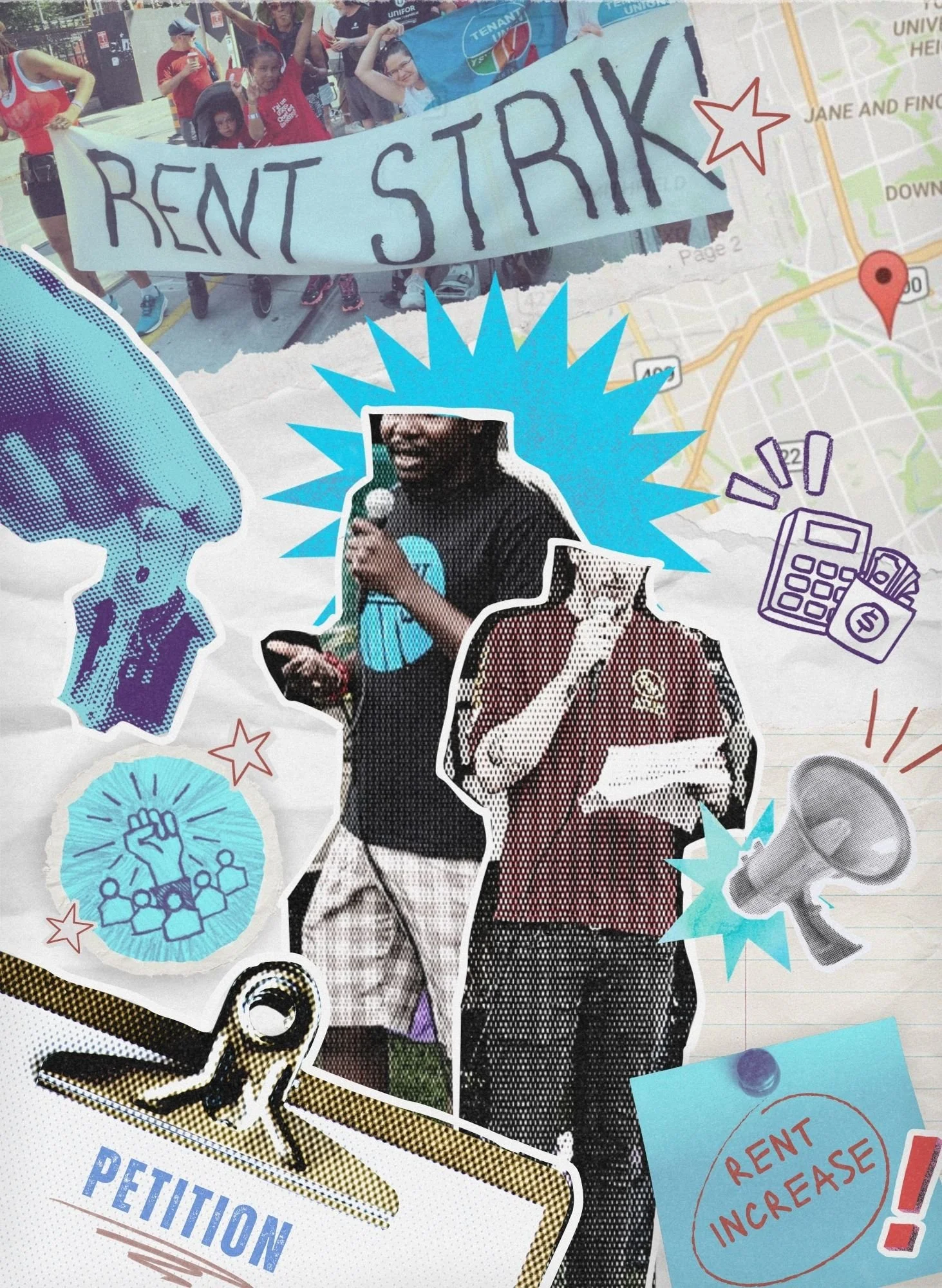
“Changing the terms under which you live”
Organizing for power in the age of sky-high rents, evictions, displacement, and neglect
By Aniket Kali
The Weston rent strike
“The rent strike was life-changing for me,” reflects Sharlene Henry. “People really came together on a mission to stick it to our landlord and tell them, ‘We are not going to allow you to [raise rents] without pushing back.’”
Henry helped lead a historic and successful 16-month rent strike. She was incensed by the seemingly endless and out-of-control rent hikes hitting her apartment building – a 27-storey building nestled in Toronto's Weston neighbourhood. “When your rent goes up $67 a month because of an above-guideline increase, and you are on a fixed income or not making more money, it affects every aspect of your life,” she says.
It isn’t just $67, once, though. It’s $67 each month the first year, then $71 the next, then $76 the one after that – compounded year after year, each increase stacked atop the last. It becomes the food you didn’t buy. The medicine you stretched. It becomes the time you skip a fun outing – which should not be a luxury, but a basic part of being a human who participates in the world.
In Ontario, landlords adhere to rent control. They can raise rents between one and three per cent every year. Sort of. Not really. Sometimes they ask for – and almost always get – above-guideline rent increases (AGIs). It's a funny little trick: tenants complain about ongoing neglect and lack of repairs, then landlords claim to be making upgrades in response, so the courts allow them to raise the rent above rent control limits. In Henry’s building, she says they tried to pull this funny little trick 12 times.
But her fight was about more than just the bottom line. Weston is one of Toronto’s few relatively affordable neighbourhoods. It’s where numerous Black immigrants, their children, and their children’s children, have said: we are here. We will be here. We deserve to be here. No matter the cold number-crunching of bureaucrats and developers, we will have a neighbourhood by and for the working immigrants who make this city a place worth calling home.
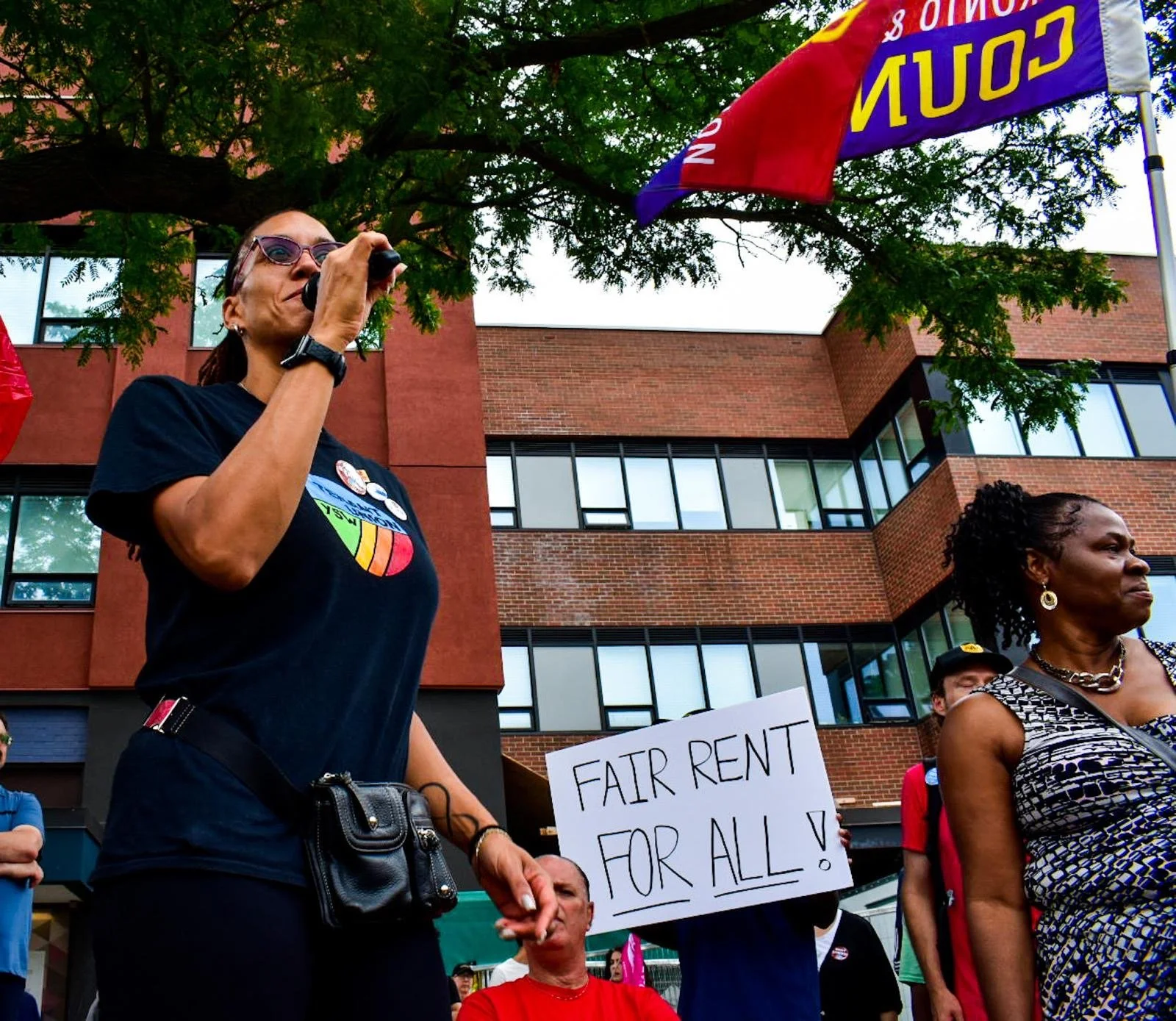
Tenant organizer, union member, and autoworker Sharlene Henry helped lead one of the biggest rent strikes in Canada.
Henry will tell you she’s a Toronto girl – not from here, but here since the age of four, with her single mother. “My kids go to the same community centre where I went for after-school programs. It is our community. The roots are deep. People do not see that.”
Her neighbours saw it, and set their imaginations to work on possibilities for protecting their homes. It started with Henry and a crew of retirees in 2018 who organized meetings and raised awareness. In 2020, her building came together with others in the neighbourhood to put their faith in an idea that had little history in Canada. They called that idea the York South-Weston Tenant Union (YSWTU) – now amalgamated with Climate Justice Toronto into the Toronto Tenant Union as of April 2026. Henry’s own experience as an autoworker and a Unifor member gave her a framework for how to organize and lead and she would later become the tenant union’s co-chair.
The union tried everything they could think of in the following years: petitions; work orders; calling the property management in groups; public demonstrations; media stories; and calling upon their city councillors, members of provincial parliament (MPP), and MPs. Nothing seemed to work; the rent just kept rising. It was Henry’s mother Theresa who posed a new, daring idea in 2023: let’s just stop paying. Some thought their union was out to lunch. But resistance can begin in seemingly unlikely places. “We had some retirees in their 70s and 80s who held back their rent and said they believed in what we were doing,” recalls Henry.
With over 200 tenants withholding rent at the height of the strike, 16 months of defiance won them action on concrete demands: court-ordered repairs after years of neglect, and official recognition of the union as the collective voice of tenants. It was a remarkable victory and one beyond imagination a few years prior. The lives of these tenants had seemed to be already written: quiet submission to neglected repairs and rent increases, struggling to make ends meet, and total surrender to the market. But they instead chose to rewrite their lives together. In a building where Henry estimates many had never even voted, hundreds learned that their dignity could be fought for and won.
“One of the retirees said to me that a hundred years ago people got arrested for being involved in a labour union,” Henry recounts. “He said maybe in 50 years [...] it will just be normal that tenants are part of a union that helps protect their rights.”
Doug Ford’s Bill 60
Growing up in Karachi, Pakistan, Hadya Ashraf saw how politics determined people's fates. Politicians were the arbiters of whether pipes carried clean water or dirty water. They put up the walls of the gated communities. They called some people’s struggles worthy, while others were just rowdy. She grew up among people debating, critiquing, and questioning the world around them, and they taught her not to close her eyes. So when she came to Canada at 18 years old, she kept them wide open.

In the face of Ontario’s Bill 60, Hadya Ashraf, along with her neighbours and the Toronto Tenant Union, is in the process of organizing her suburban Etobicoke building.
The attack on renters was entirely predictable. Having already let rents soar and ended rent control in buildings built after 2018, Doug Ford’s Progressive Conservative government introduced, and eventually passed, Bill 60 in the fall of 2025. It makes evictions easier, takes away tenants’ rights, and, for good measure, has the potential to make an effective blacklist of tenants who run into any legal trouble.
But these tenants would not just stand idle. Ashraf knew that if politics writes the story of people’s lives, then people working together could write the course of politics too. Supported by organizers from the YSWTU and Climate Justice Toronto (CJTO), she brought together her neighbours in the lobby of her 25-storey suburban Etobicoke building to talk about Bill 60. It was part of an effort by both groups that knocked on 10,000 doors across the region.
Her neighbours spoke up one by one on that cold November evening in 2025. Pests. Shoddy maintenance. Water leakages, and then water shutoffs. That funny little trick called an AGI. The despair of a single mother with four young kids and barely any money after rent. The resignation of long-timers who had nowhere left in the city they could afford. The indignation that the government and its corporate landlord lobbyists would, once again, make things worse for them. And then, one by one, eyes opened. There was palpable relief that what had been kept silent for so long was now audible, shareable, and political.
None of these woes were a surprise to Ashraf, who reflects that “when housing is treated primarily as an investment or a source of profit, the outcomes we see – neglect, displacement pressure, renovictions, and a lack of accountability – are not accidental.” But in order to build a fighting union, she had to frame that insight for her neighbours: “Are we going to keep dealing with [these issues] on our own, or are we going to try to approach them together?”
It isn’t cynicism alone that weighs down her neighbours, but the grind of working-class life. One Filipina woman contributes wisdom, experience, and understanding – the irreplaceable kind only earned by years of organizing back home. But she’s at capacity. She has two kids, two jobs, and at least two kinds of infestations.
Ashraf has nothing but empathy for neighbours like that: “I start from where they are at.” She knows it takes time to trust and build those relationships. But joining a tenant union isn’t just about taking on another commitment while barely afloat, she acknowledges. “It is about changing the terms under which you live.”
In the new year, Ashraf brought the tale of the Weston rent strikes to her neighbours in the form of a documentary. It showed them that it was not only possible to fight for better living conditions, but that tenants just like them had already won, just a bus ride away. Soon it would be them who started collecting signatures for a petition – together.
Building a fighting union
Looking back on the strike, Henry reflects, “Most of the people who went on the rent strike in our building had never organized.”
There is no shortage of tenants who know that when the rent goes up yet again, they are being robbed. Who are furious, quietly or loudly, and without a target. Fury of that nature does not stay put. Recent years have seen elites, well-funded and having strategized across decades, opportunistically bend the rage about the housing crisis toward minorities, immigrants, and homeless people in encampments. They point it anywhere but up, lest someone find the real culprit.
A tenant union is a tool for renters to have agency in their own lives, and to guide their fury back to its rightful target. It is a refusal to be drawn in, spat out, and left cynical and disillusioned by the endless promises of corporate-friendly politicians. “[Tenants] realized they approached their MPP, MP, and city councillor and those people did nothing to make things better,” Henry says. “They learned that if we want change, we have to do it collectively and through grassroots action.”
In her latest lobby meeting, Ashraf worried few would want to escalate their fight, let alone work together on strategies. Instead, sharing their experiences and issues as tenants made them feel less isolated, built community, and moved them to act together. She reflects afterward, “People are starting to see themselves as part of something collective rather than dealing with things alone. Moments like that are really worthwhile because you can see the beginnings of collective consciousness forming in real time.”
Aniket Kali is an independent journalist and lapsed linguist based in Toronto, interested in immigration, diaspora, and political and social movements. He is a founding member of the Toronto Tenant Union and was previously a member of Climate Justice Toronto.