
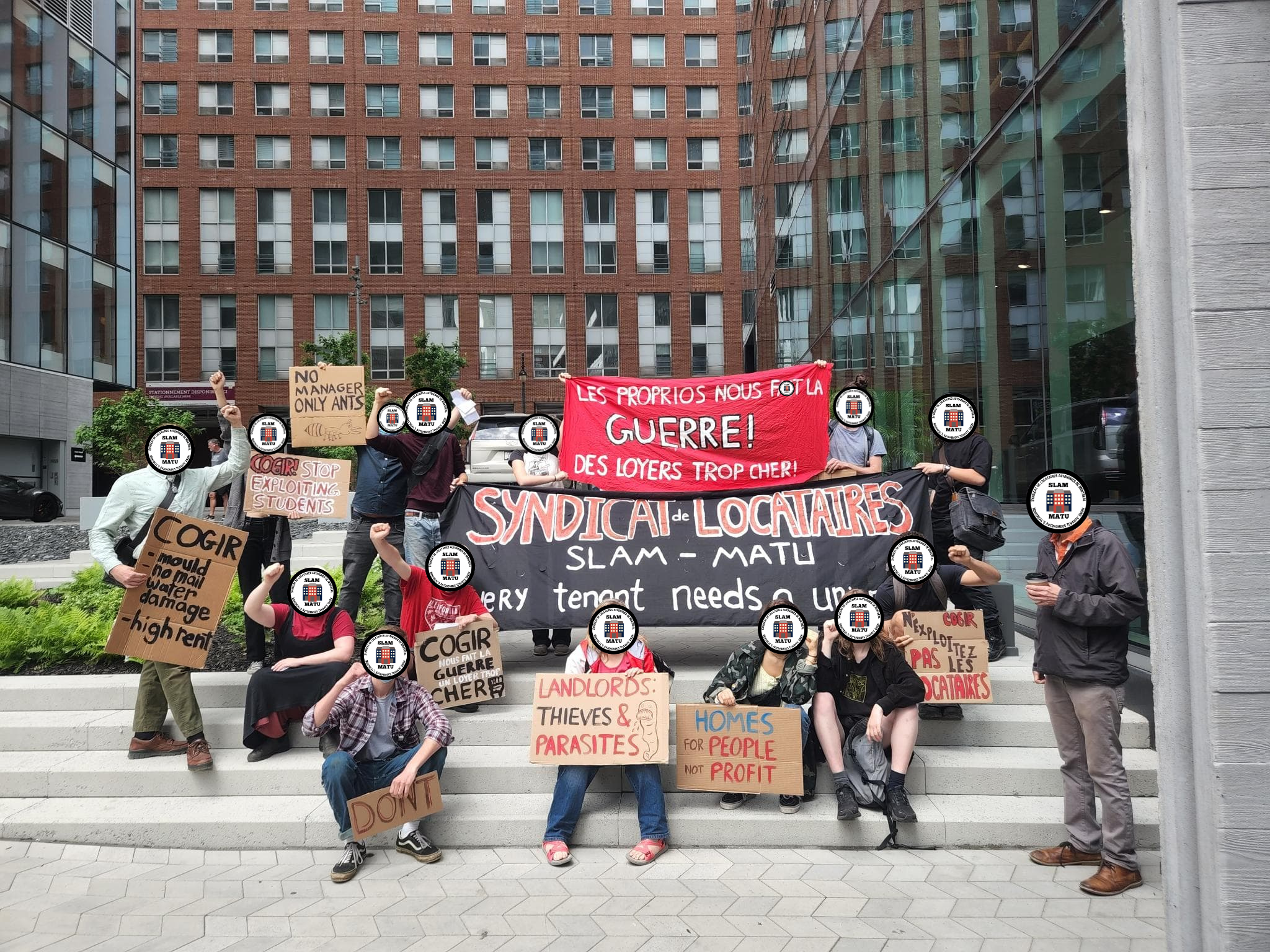
A group of tenants and members of Montreal Autonomous Tenants’ Union/Syndicat des locataires autonomes de Montreal confront corporate landlord Cogir outside their offices. Photo submitted by authors.
Expropriate to liberate
How a Montreal Tenants’ Union is Fighting to Expropriate Everything
By Becca H. & Cléo Clamen
Walk down the street in many neighbourhoods in Montreal, and you won’t go more than a block without seeing a poster for the Montreal Autonomous Tenants’ Union/Syndicat des locataires autonomes de Montreal (SLAM) on a building, street pole, or bus stop. One popular poster includes a photo of people marching with an “exproprions les proprios” banner (“Expropriate landlords,” in English).
SLAM is a union made up of tenants helping each other out. We’re all volunteers, and we structure ourselves non-hierarchically. Many people approach us looking for help with their housing, but our mission extends beyond helping tenants on a case-by-case basis.
SLAM’s long-term goal is to put housing in control of the people who live in it, explains SLAM member Owen*. “Landlording as an institution has to end,” he says.
The issues we face as tenants – such as high rents, poor living conditions, and evictions – are not individual struggles caused by “bad apple” landlords. The current housing crisis is the inevitable result of our housing system, which is controlled by a small group of people profiting from the universal human need to be housed. As a result, better rent controls, anti-eviction legislation, or more social housing will not bring about housing justice. Instead, we work toward the long-term goal of decommodifying housing and abolishing landlordism.
“People see landlording as something that’s legitimate, something that’s morally acceptable to do [...] If everyone [recognized] landlordism for what it is – pure exploitation – [...] it would be much easier for us to take control of housing for ourselves,” Owen says.
The limits of tenancy boards
Many tenants have been sold an idea that the way to get restitution from landlords is through tenancy boards such as the Tribunal administratif du logement (TAL) in Quebec, the Residential Tenancy Branch in B.C., and the Landlord and Tenant Board in Ontario. However, these dispute resolution bodies are fundamentally flawed.
Enforcement generally falls on tenants – requiring them to know how to navigate the intricacies of housing laws – and rulings frequently favour landlords. Landlords also shape housing policy through landlords’ associations and electoral politics. In 2024, David Mastracci of The Maple created a database of Canada’s then-federal MPs and their ties to real estate either through investment, ownership (or property other than their personal residence), or landlordism by them, their spouses, or dependents. Mastracci’s data found approximately 40 per cent of the 332 MPs reviewed (two had not disclosed data) fit the criteria. The Maple also has 2026 data for provincial representatives available on their website.
“Our tenant rights are carve-outs of landlord property rights. A landlord’s right to make profit off of his property is structurally prioritized over the right of tenants. Because of this, the TAL structurally cannot give us housing for all,” SLAM member Jean* explains.
Often, the only way for tenants to win is to organize together, engage in direct action, and take matters into our own hands.
Solidarity and direct action
In 2022, SLAM supported a campaign against corporate landlord Cogir. Tenants in several buildings faced problems including widespread pest issues, unusable mailboxes, flooding, and mould.
To respond, tenants formed building councils, organized a barbecue, and passed around a petition. Then, they turned to direct action – a group of Cogir tenants and union members entered the marble-walled Cogir offices holding banners and signs. They gave a speech explaining the disrepair of their building and laying out demands, and after about 30 minutes of disruption, a Cogir representative agreed to negotiations. The tenants reported eventually getting repairs done and receiving compensation for previously neglected repairs.
“The landlord didn’t know what to do,” says SLAM member Jean. “Showing up to their office puts them on their back foot.”
We often see fellow tenants caught up in “pessimism bias.” Poor living conditions can cause immense stress, taking over our lives and causing us to feel hopeless. This dynamic is worsened through the atomization experienced by many in our hyper-individualized society. When we organize together – building relationships with our neighbours, seeing that our housing problems are shared, taking combative action against our exploitative landlords, and winning tangible improvements – this pessimism can turn into hope.
In the case of the Cogir campaign, organizing had a big impact on the tenants. “[The tenants] were able to get in the landlord’s face and make it their problem,” SLAM member Emma* says.
One of the most effective strategies in tenant organizing is the rent strike, which has won victories for tenants across North America. One recent example is the 2017 strike in Toronto’s Parkdale neighbourhood. Three hundred tenants across 12 buildings fought against above guideline rent increases with a months-long rent strike and successfully secured rent relief for struggling tenants, reduced rent increases, and negotiated an agreement with the landlord to address the widespread disrepair and pest infestations in their buildings.
Expropriations
“We are trying to build a mass tenant movement that is combative enough and organized and powerful enough that we could launch an indefinite [rent] strike,” Emma explains. Achieving a city-wide strike could allow tenants to collectively manage their buildings through councils, potentially leveraging networks formed by past tenant organizing, such as the collective formed by the Cogir tenants.
Despite the normalization of landlord-run housing, thousands of people in Quebec already live without landlords: over 50,000 people live in housing co-operatives, where residents collectively manage apartment buildings, and in Montreal, an additional 19,000 households operate under non-profit housing managed by organizations rather than landlords. Models for decommodified housing structures already exist.
One common way for tenants to take back control of their buildings is through expropriation, like in the neighbourhood of Exarcheia in Athens, Greece. Many buildings in Exarcheia were squatted in and turned into free housing throughout the 2010s, primarily for refugees.
But isolated attempts at expropriation have a limited impact. For example, while having been home to thousands of people, many of the squatters in Exarcheia buildings have since faced evictions.
“The problem with expropriating housing right now is [that if] any one person, any one building, [or] even any fairly large groups of people do that, the state has the power to put you down,” explains Owen, who believes long-term success requires mass mobilization and the weakening of state power.
“The liberation of ourselves from rent will not necessarily be a struggle against rent,” adds SLAM member Hersh*. He believes that a broader uprising is required, citing the 1931 rent strike of 100,000 tenants in Barcelona which is seen by some socialists as a key precipitating event to the 1936 Spanish revolution. Large numbers of people stopped paying rent, organized through mass meetings of the Comité Defensa Económica of the Confederación Nacional del Trabajo, the country’s anarcho-syndicalist labour union. Years later, during the 1936 revolution, millions of workers and tenants mass expropriated capitalist industry and housing and began running industry and property co-operatively, through unions and communes.
Further historical examples of rent strikes in moments of uprising include the 1790–1792 peasant revolution in Corbières in France – where many villagers stopped paying rent to absentee landlords – and the Ireland Land Wars in the 1870s–90s, which saw widespread rent strikes. For a model of local organization, many in our union look to the neighbourhood communes that were recently organizing in Rojava (also known as the Democratic Autonomous Administration of North and East Syria), a de facto autonomous region governed by the principles of feminism, direct democracy, and libertarian socialism.
Long-term revolutionary goals
SLAM works toward a revolutionary horizon alongside other groups. “[We are] not just a tenants’ union that fights for housing-related [gains] but we’re part of an ecosystem,” Emma says. “We’re working on one piece of the puzzle, and we can’t reach our long-term goals without a broader, combative movement and network of people who are looking at different pieces of the puzzle.”
The piece offered by tenant unions can be substantial. For one, successful tenant organizing that results in lower rents and better living conditions can give tenants more time and energy to organize around other issues. Housing organizing campaigns give tenants analytical frameworks, tools, and experience that can be applied to other struggles. Building relationships at the neighbourhood level means that people have networks outside of the state to rely on during times of crisis, natural disaster, and repression; or which, by throwing themselves into action, can take the offensive during moments of uprising.
The day the TAL announced its 2026 rent increase guidelines, SLAM members and supporters threw hundreds of pamphlets across the floor of the tribunal’s office. A small slogan printed within captures our approach: “We will not pay for the riches of landlords! Today, we fight rent increases through solidarity and direct action. Tomorrow, we expropriate our buildings and liberate our neighbourhoods.”
*Owen, Jean, Emma, and Hersh are pseudonyms used to preserve the benefits of anonymous political organizing.
Becca H. and Cléo Clamen are members of the Montreal Autonomous Tenants’ Union.