
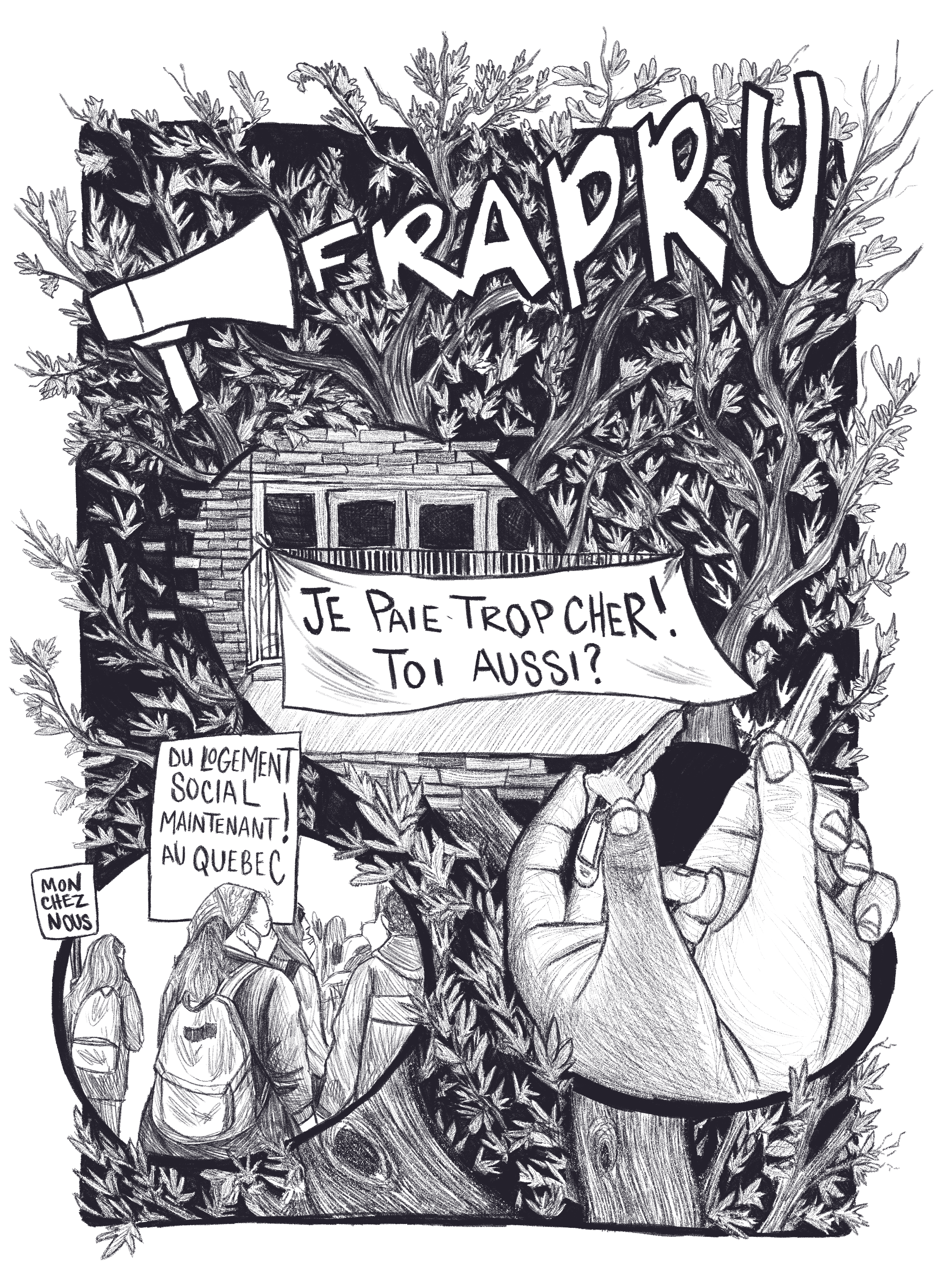
Illustration by Casper Slack
FRAPRU and Quebec’s grassroots struggle for co-ops
An interview with Front d’action populaire en réaménagement urbain coordinator Catherine Lussier
By Stefan Christoff
This interview has been condensed and edited for clarity.
From coast to coast, grassroots organizing around housing justice is growing. But as my discussion with Catherine Lussier, the coordinator of Front d’action populaire en réaménagement urbain (FRAPRU), demonstrates, this work is far from new. FRAPRU is a grassroots organization in Quebec that has been engaging in this struggle for decades. My conversation with Lussier traces the formation of a community organizing network across Quebec, founded in 1978, that connects groups of local housing associations to a large system that has consistently asserted demands for more social housing and for tenant rights.The work of FRAPRU ranges from local case work within the network’s member associations to support individuals who are fighting unjust rent hikes or facing eviction to larger collective demands for housing justice.FRAPRU is a key part of the fabric of social movements in Quebec and central to supporting some key wins in community organizing for housing justice, including the expansion of housing co-ops across Montreal in the 1980s. This interview is a window into how grassroots groups can come together across generations, acting autonomously at a local level while coordinating on a broader level to make collective demands. They have held countless open meetings, assemblies and legal clinics on tenant rights, while also organizing major actions and marches in Montreal and throughout Quebec.Stefan Christoff
Across Quebec and Canada there is a lot of conversation among social activist circles about tenant unions and building the collective capacity of tenants to organize and demand just housing conditions. I am sitting in the office of FRAPRU here in Montreal. This organization has been building support for local groups across Quebec – member associations of FRAPRU – which are doing on-the-ground work with tenants and also more generally around housing justice.
Catherine, could you start by sharing a bit about FRAPRU and why you feel it is important to reflect on the role of an organization like FRAPRU in this moment?
Catherine Lussier
FRAPRU is an umbrella organization that brings together tenant associations, housing committees, and neighbourhood groups. There are close to 150 member associations across Quebec. This includes groups focused on the feminist movement and migrant justice groups, but housing – specifically, social housing – is at the core of the work that we do at FRAPRU. Our belief is that pushing for more social housing is really at the centre of making a more just housing reality possible.
Stefan Christoff
To get a picture of how FRAPRU works locally, it would be meaningful to learn how FRAPRU supports groups like P.O.P.I.R. – Comité Logement in Saint Henri or the Comité logement in the Plateau-Mont-Royal, for example. Could you describe the process a bit, given that there aren’t organizations like FRAPRU in other parts of Canada?
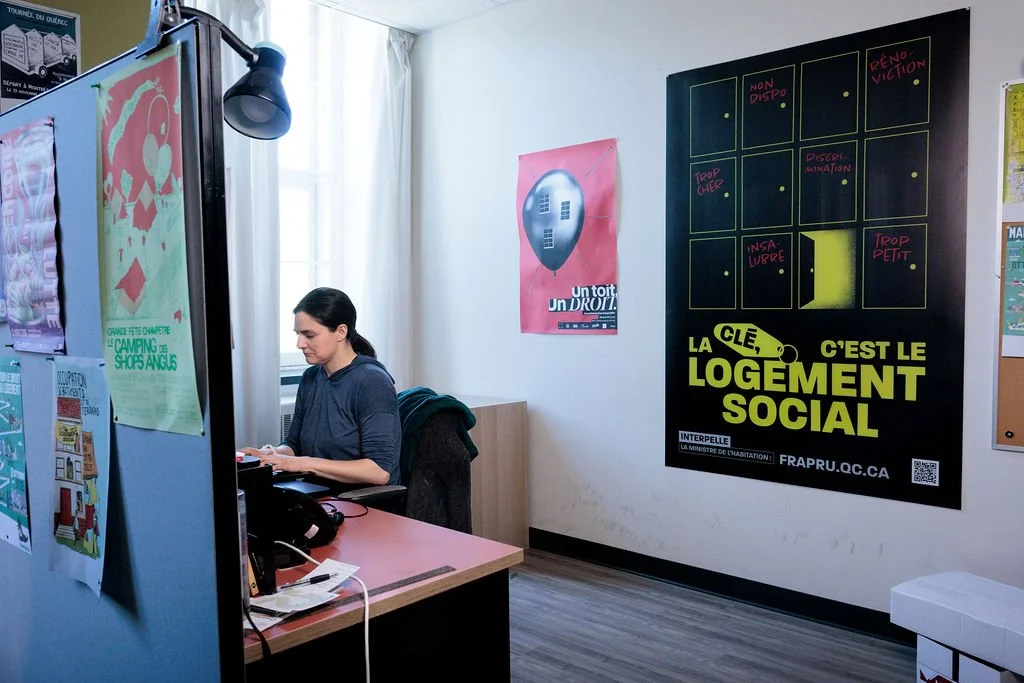
Catherine Lussier pictured in the Front d’action populaire en réaménagement urbain office in Montreal. Photo by Alma Perreault.
“FRAPRU is really coming from local tenant associations, residents in different areas, and tenants who were facing urban challenges at the time that the umbrella group was founded.”
Catherine Lussier
Most of the time the local committee is really there to support tenants by sharing legal information on their rights, but also doing local case work, supporting folks who are facing unjust rent hikes or evictions, etc. The local groups also do region-specific popular education on both the larger political context around the housing crisis and the specific ways that tenants can demand their rights collectively.
Stefan Christoff
That collective question is very interesting and important – bringing together different local folks who are facing related issues, with maybe different contours in the specific cases, [but] with some larger overlap at a systemic level. FRAPRU brings together all of these local associations and then can formulate a larger political demand or perspective about the housing crisis more generally. So that creates a platform to demand more social housing and support for co-ops as well.
Catherine Lussier
FRAPRU is really coming from local tenant associations, residents in different areas, and tenants who were facing urban challenges at the time that the umbrella group was founded.
Stefan Christoff
Not unrelated to the challenges that people are facing today.
Catherine Lussier
Yes. Specifically at the time when FRAPRU was founded, the city was facing a massive top-down construction boom, with new highways being built and major parts of neighbourhoods being destroyed.
Stefan Christoff
Like in the 1970s and early ’80s when Ville-Marie Expressway was being built, and the construction of Complexe Guy-Favreau and the Palais des congrès were happening, which destroyed a bunch of housing, particularly in Chinatown.
Catherine Lussier
Yes, in this context, local residents were coming together to fight against specific situations. In 1978, the network became more formalized. The FRAPRU started very small with local tenants; then it became clear that having a larger network where people could fight for housing together was something that they wanted and that was important. The combining of so many groups meant they could assert collective demands to both the provincial and federal governments through a network that really represents local tenants.
Stefan Christoff
Right now that process is driven by the financialization of housing.
Catherine Lussier
Exactly. So social housing can be understood as a way to remove housing from the market and create housing that belongs to the community, like co-ops, or low-income housing and social housing – which has an important public element – through accessing state funds.
Stefan Christoff
Which are really public funds collected from our society – we can push those funds toward non-market housing options that are viable.
“Right now we are really focused on the reality that with the current dynamics at play, we are [concerned with losing] that public funding for non-market housing. This is happening through governments creating a larger role for private financing for things like public housing.”
Catherine Lussier
Yes, exactly. Right now we are really focused on the reality that with the current dynamics at play, we are [concerned with losing] that public funding for non-market housing. This is happening through governments creating a larger role for private financing for things like public housing. Right now we are really preoccupied by this dynamic because that will push social housing to be more connected to free-market forces, which is not good. With this type of shift we would see fewer resources going into building housing that is administered collectively outside of the market, like local low-income social housing and co-op housing.
Stefan Christoff
These distinctions are important. I wanted to ask you about one important aspect of mass organizing for tenant rights: co–ops and how and why they are important to this city. To underline, co-ops didn’t come from nowhere – a special spaceship didn’t come to drop off some co-ops for people. Instead, we can understand that people got organized and fought for them.
Catherine Lussier
There were a number of important cases in Montreal where some non-profit associations got together and decided that co-ops were a good way to address the needs of the tenants. Pushing for co-ops is important, just like pushing for non-prof- it housing and social housing.
Members of co-ops are really involved in the process. They survive because of group work, not top-down decisions.
“When you’re a part of a co-op, you work together to keep the co-op in a good state, you work on the repairs together, and work to keep the building up.”
When you’re living in a co-op, you often can’t avoid the fact that its future is tied to the mobilization of its members. When you’re a part of a co-op, you work together to keep the co-op in a good state, you work on the repairs together, and work to keep the building up.
There are some tenants for whom this model doesn’t work given their life circumstances, so there needs to be other options for those folks; non-profit housing could be a fit. For people housed in larger non-profit [housing], there is less day-to-day involvement required compared to most co-ops. While there are still ways to be involved in these larger non-profit housing associations – such as by joining the board or committees – it is generally not required, while in co-ops it usually is required.
Stefan Christoff
Are there examples of meaningful and interesting co-ops in Montreal that you could share with the readers?
Catherine Lussier
In the case of Coopérative d’habitation Angus [Housing Coop], 40 per cent of the land was preserved for the construction of social housing. Co-op housing makes up a lot of that, but not exclusively. There are also non-profit associations present. This is a result of collective fights with local residents wanting to define what will happen with the housing possibilities in that area. In this case, activism secured 40 per cent of the whole site!
Stefan Christoff
For people who don’t know the location or neighbourhood that you are talking about, could you explain?
Catherine Lussier
Yes, Angus was an old industrial complex of land that was unused for a long time; then there was a decision to remodel the land [from the Canadian Pacific Railway’s real estate subsidiary Marathon Realty]. It was formerly an industrial lot in Rosemont. People fought for having a lot of co-ops and social housing in this area back in the 1980s. Today you have co-ops there that remain really affordable in contrast with the rest of the neighbourhood which has gotten very expensive.
Another example would be in Parc Ex – I might be a little biased because I also worked in Parc Ex – but it is a neighbourhood in Montreal, one of the poorest in Canada, where people actually fought for their co-op and were able to get financing and land permission to get working on the co-op project land. It is called Coopérative Monde-Uni. They are constructing the co-ops right now and it is really happening because of the neighbourhood working together to make collective demands. This project is excellent because they actually consulted with the neighbourhood at large, so it speaks to the needs of the neighbourhood. The mobilization and activism around this project actually created a lot of pathways for it to be integrated into the local fabric. This underlines that all social housing really does need to be a part of the local con- text; that interwovenness is very important. Top-down models really don’t work for social housing.
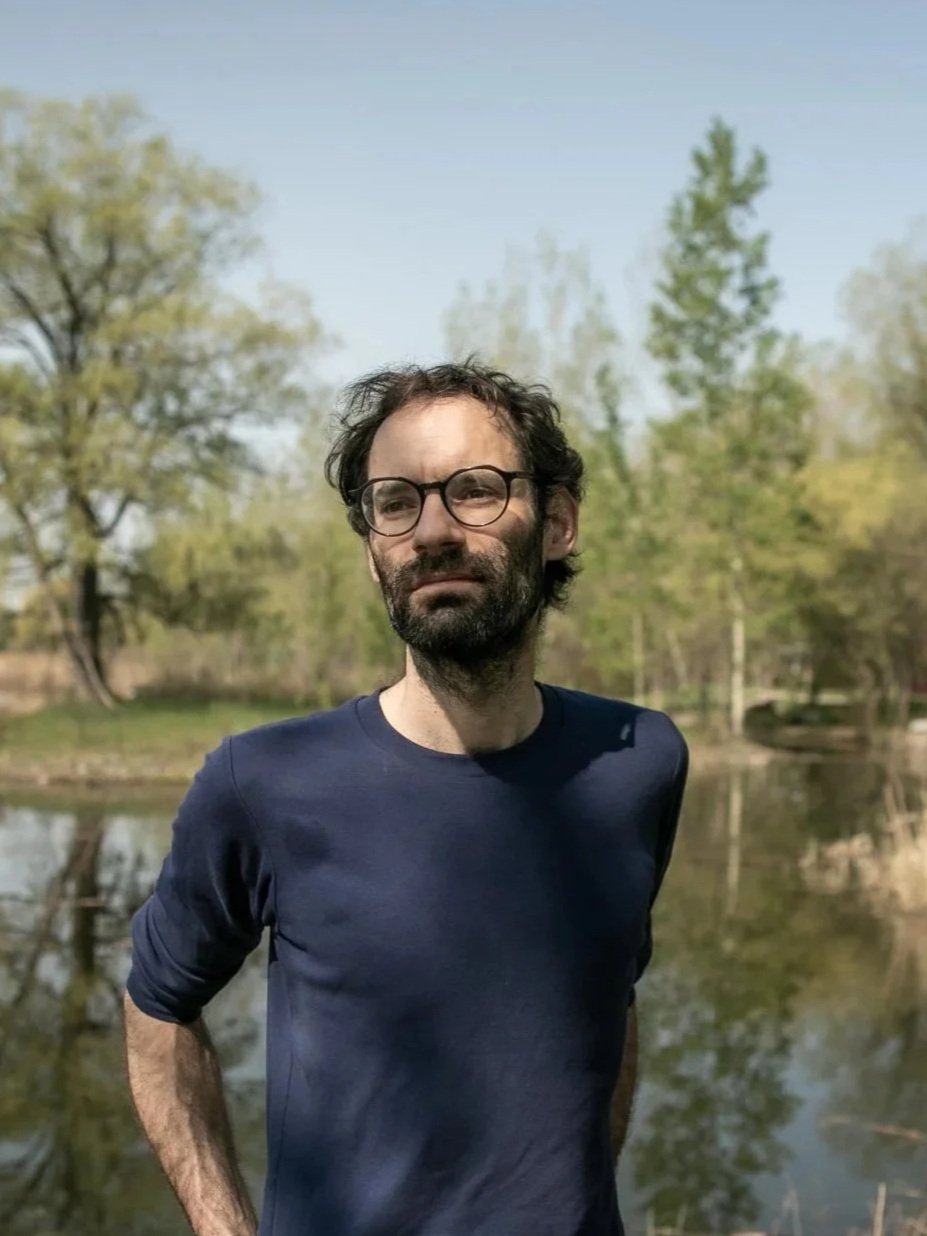
Stefan Christoff is a media maker, community activist, artist, and graduate student living in Montreal. Stefan hosts Free City Radio, makes music with many people globally, and is a regular contributor to Radio AlHara in Palestine. Stefan recently edited the Voices for Housing Justice zine following the 2025 housing justice convergence in Montreal.