
Amanda Priebe
Gaining Ground
Keeping community in Canada’s community land trust movement
By Nat Pace
The first organization to call itself a community land trust (CLT) was New Communities Inc. (NCI), founded in 1969 in Georgia by civil rights organizers seeking land security for Black tenant farmers. At its height, it stewarded nearly 6,000 acres – making it one of the largest Black-owned landholdings in the United States at the time – on which NCI planned to develop a utopic agrarian community. While discriminatory policies, debt, and drought kept this dream from becoming reality, the community land trust model has grown into a global movement, with a highly active Canadian front.
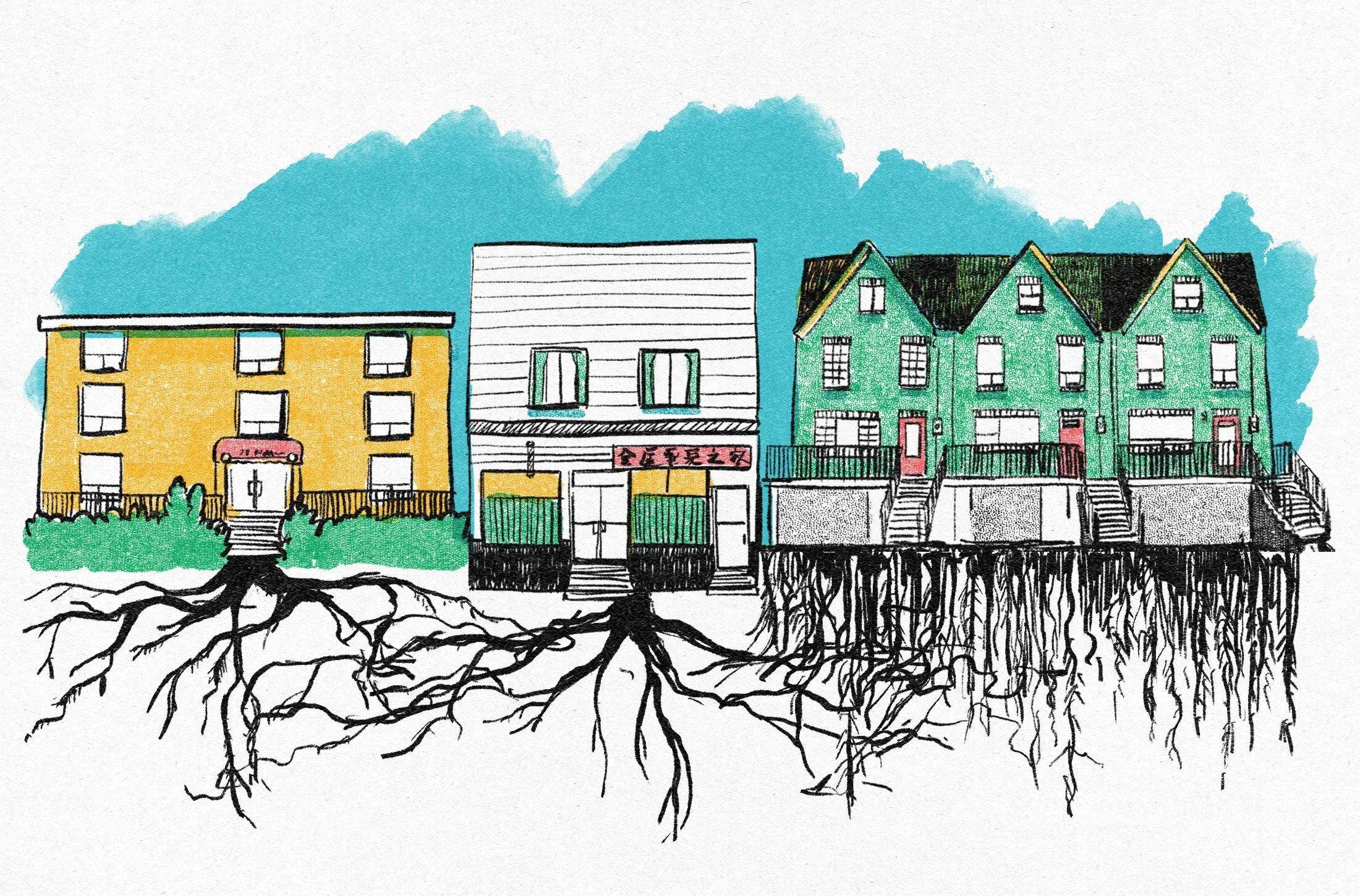
The core principle of a CLT is simple but powerful: land is held in trust for community benefit, rather than treated as a commodity for private profit.
While CLTs retain ownership of their land, they lease out land and buildings to non-profit housing operators, housing co-operatives, individual households, small business owners, social enterprises, and so on. In some cases, such as Whitehorse, Yukon’s Northern CLT, they may enter into long-term ground lease agreements that enable a form of affordable homeownership.
For just $200, anyone can federally incorporate an organization and call it a community land trust. But most people in the movement agree that a name alone is not enough. As the community land trust movement continues to grow in Canada and beyond, organizers are increasingly confronted with difficult questions about identity, governance, scale, and power.
The Canadian Movement
In Canada, land trusts for affordable housing started appearing in the 1980s, with the Co-operative Housing Federation of Toronto using a land trust, Colandco, to acquire and develop new co-ops. A funding drought effectively stalled momentum in the following decades, but those homes continued to be safeguarded in the land trust.
A second wave emerged from the early 2000s through the late 2010s in cities including Edmonton, Winnipeg, Toronto, and Halifax. While not all early organizations survived, key efforts such as the Parkdale Neighbourhood Land Trust in Toronto played a foundational role in establishing the Canadian Network of Community Land Trusts in 2017.
Since the COVID-19 pandemic began, the movement has expanded rapidly. New CLTs have emerged in large cities, small towns, and rural communities. The increase can be attributed to rising housing costs, support from a national network, increased public awareness, and new streams of seed funding.
A growing part of this movement is made up of Black-led, Black-serving, and Black-focused CLTs, grounded in reparative development and cultural preservation. Examples include the Weymouth Falls Community Land Trust in Nova Scotia, which reclaimed the historic Mount Beulah Church from a planned conversion into a short-term rental property. Just a few hours away in Halifax Regional Municipality is the Upper Hammonds Plains Community Land Trust, which received $61.2 million in federal funding to develop the largest Black-led co-operative housing project in Canada.
“When we started building our organization, most people in the community had never heard of a community land trust,” Shekara Grant, executive lead of the Weymouth Falls CLT says. “What they did know was that families were losing homes that had been passed down for generations because of land disputes and tax sales. They saw churches and community centres close, halls torn down, and local stores [...] disappear. [...] The Weymouth Falls Community Land Trust was not about creating a new community. It was about protecting the one that was already there.”
Many CLTs work at the neighbourhood level, grounded in hyperlocal knowledge. Vancouver’s Downtown Eastside Community Land Trust, for example, works hand in hand with the DTES SRO Collaborative, a grassroots project organizing tenants within single room occupancy hotels to self-manage their buildings. This ethos keeps them rooted in communities facing intense displacement pressures and closely tied to tenant organizing and anti-gentrification struggles. Others operate at a regional level, such as the Ottawa Community Land Trust.
For community land trust organizers, the “housing crisis” is fundamentally a land problem: housing becomes unaffordable because land is privatized, commodified, and speculated upon. If land values are allowed to rise endlessly through speculation, housing prices inevitably follow. CLTs intervene at the level of land itself.
Like environmental land trusts, which protect ecologically significant land from destructive development, community land trusts protect land from speculative real estate markets.
Governing ethos
If successful in starting up and acquiring land, CLTs must grapple with the identity crisis of going from fighting landlords, to being a landlord.
Transitioning from an activist ethos to a land-owning organization, while keeping intact principles of anti-displacement and mutual aid, is no easy feat. Take Parkdale CLT in Toronto. Birthed from a desire to halt rooming house evictions in the neighbourhood, the CLT had to navigate the eviction of their own tenants. In 2022, the CLT took on 84 homes from Toronto Community Housing. One of the buildings faced persistent non-payment of rent. The board was split. Board directors with lived experience of homelessness insisted on no evictions. Those seasoned in the non-profit housing sector insisted on prioritizing the financial health of the building. In the end, after much turmoil, PNLT chose to evict the tenants.
As the affordable housing sector becomes increasingly focused on scale, CLTs are often celebrated as a model capable of expanding non-market housing quickly and permanently. Because they are portfolio-based organizations designed for long-term stewardship, they fit neatly into contemporary conversations about scaling affordable housing supply.
But scale can come with trade-offs. The more CLTs are positioned as technocratic tools for efficient housing delivery, the easier it becomes for community governance to fall to the wayside in favour of landlordship and asset management. Public institutions and funders may support CLTs not because they redistribute power over land, but because they appear capable of managing affordable housing portfolios effectively.
No amount of community governance changes the fact that Canada is a settler-colonial state. CLTs may challenge land commodification and displacement, but they remain embedded in colonial legal and property systems. Meanwhile, Indigenous peoples continue to disproportionately experience some of the most dismal housing conditions in the country.
For some organizers, this contradiction can make CLTs feel politically insufficient. The model offers an alternative to speculative real estate, but it does not resolve questions of Indigenous sovereignty or land restitution.
Still, a growing number within the movement see this tension not as something to avoid, but as a political problem with which to actively engage.
Increasingly, CLTs are experimenting with decolonial governance practices: establishing Elders’ committees, reserving board seats for Indigenous representatives, and building long-term relationships and land-sharing agreements with Indigenous communities and organizations.
In several places, Indigenous communities are organizing their own land trusts, such the Temiskaming District CLT in Northern Ontario, and the Calgary Urban Indigenous Community Land Trust. These groups often see their projects as a way for urban Indigenous people, who live off reserve or perhaps are not members of a First Nation, to collectively steward land.
Lisa Neil of the Temiskaming District CLT explains that to address the specific gendered violence and systemic racism Indigenous women encounter, “[t]here is a need to establish an Indigenous governed land trust that will allow for Indigenous women to own, design, and build their own housing models. The land trust model will further allow for Indigenous ways to be incorporated in the very governance and processes of the [Temiskaming District] CLT.”
Maintaining ethical roots
Community land trusts were never meant to be simply non-profit landlords. At its best, the model is designed to embed democratic governance and community participation.
Through community bond campaigns, Ottawa CLT, Brique par brique (Montréal), and Kensington Market CLT (Toronto) have collectively raised millions from local supporters to acquire land and buildings. Their success demonstrates the ability of community land trusts to mobilize local capital and anchor wealth within communities.
CLTs, like Brique par brique and Kensington CLT, typically have open membership: anyone living within the trust’s geographic area – not only residents of CLT-owned housing – can become a member. Members elect a board that usually includes three groups: residents or leaseholders, broader community members, and representatives with relevant expertise or lived experience. They are active stewards, often acquiring existing rental housing at risk of renoviction and, increasingly, developing new housing directly.
In 2025, the Parkdale Neighbourhood Land Trust was selected by the City of Toronto to develop Parkdale People’s Place, a 16-storey building with 175 rental homes and 23,000 square feet of community space. First dreamed up in a community-led planning exercise 10 years ago, Parkdale People’s Place demonstrates that development can be led by communities, not imposed on them.
Opening up Space
The model is flexible enough to support many different kinds of initiatives. That flexibility is both a strength and a challenge; it enables adaptation across contexts, but it also makes the boundaries of the model harder to define and communicate.
In Canada, growing political attention toward housing affordability has created new funding opportunities and public interest in non-market housing models, but the movement has always been broader than housing alone.
Some CLTs are working to preserve affordable commercial spaces for small businesses. Others are protecting cultural venues, artist workspaces, farmland, and community gathering places. But these areas are underexplored and certainly underfunded. As governments increasingly frame CLTs primarily as affordable housing delivery vehicles, some organizers worry that the broader vision of community stewardship could become siloed into housing production alone.
As we move forward, we must think about what defines a CLT. Does it have a member-led governance structure? Permanent affordability? Or is it a broader political orientation rooted in critiques of land as a commodity? These questions matter because CLTs are not a distinct legal category. Most are incorporated as non-profits or charities. What distinguishes them is not legal form, but a shared ethos: collective stewardship, democratic governance, and removing land from speculative markets.
CLTs do not resolve the tensions of land, community, and power. They make those tensions visible, and insist they be worked through in public, over time, on the ground.

Nat Pace was the inaugural director of the Canadian Network of Community Land Trusts, from 2022–2026.