
Patrick Kyle
“Mom-and-pop” landlords: a political cover for financialized housing
But not in the way you think. These landlords hardly exist, yet are the centre of discussions across the country – a myth propagated to create a more favourable tax system for corporate dominance.
By Isaac Peltz
Drip, drip, drip.
The faucet on Alexandria’s* sink wouldn’t shut off. Maybe there was a faulty cartridge inside. Maybe it was just rust, or a calcium buildup. At least 7,000 of litres of water a year down the drain.
She called her landlords to ask if they would fix it.
“I got told off when I asked when there would be a replacement,” she said. “I avoid them at all costs. I only ask for repairs when it’s absolutely necessary. I only stay here because the rent is absurdly cheap for Vancouver.” Still, she loves the apartment; she simply wants repairs to be done in a timely fashion.
Chris and his wife lived in a newly renovated building in Hamilton, but quickly found that the landlord, who owned the building through a holding company, wasn't willing to maintain a single thing. If something broke or wore out, the landlord would ignore calls and emails. Now, long after they’ve left the apartment, the landlord is trying to get them to pay utility bills on the apartment, despite no longer living there. Chris wisely kept record of every interaction he had with the landlord.
The “mom-and-pop” landlord is often touted as the best kind of landlord for renters. It’s achieved a mythical status, one cited by the media in articles that talk about how tough it is to be a landlord, and as a goal that Canadians used to be able to achieve, but now find completely out of reach. There are endless articles that talk about the struggling landlord, but many fewer that discuss the need for rent and vacancy control.
“Mom-and-pop” landlords are usually thought to be one person, maybe two people who own a building for the purpose of renting. They might live in the building, renting out their other units. Or they might live in a house down the road. The idea remains the same: someone reliable who could be considered a neighbour.
Mom and pop are going extinct
The “mom-and-pop” landlord is a misnomer for one simple reason: it’s probably not a family who owns the building. It’s more likely to be small investors interested in making a profit.
Ricardo Tranjan, a researcher for the Canadian Centre for Policy Alternatives, in his book The Tenant Class, writes, “The widespread notion of ‘struggling landlords’ is a grave mischaracterization of the rental market. In fact, Canada’s landlord class comprises wealthy families, small businesses, corporations, and financial investors.”
An estimated 38 per cent of tenants are renting homes not specifically built for renting, but built to be inhabited by the owners – basement suites, sectioned-off houses, detached suites, etc. Most of these landlords own their personal homes as well as a second home which they can rent out above the cost of renovation and maintenance. Average house prices in Canada hover around $650,000 as of the beginning of 2026 – though this number will fluctuate and could be much higher depending on where these properties are located.
More than one in five property owners are also investors (those who own at least one residential property not used as their primary place of residence) and not an idealized live-in landlord: the owner-investor (someone who owns a single property with multiple residential units, one of which is their primary place of residence). Either way, these landlords are not as harmless as they’ve been portrayed. Even in provinces with supposed rental protections, tenants are subject to precarity. Landlords in Ontario and B.C., for example, often evict tenants through the own-use loophole – Ontario’s landlord own-use applications skyrocketed from 2020 to 2023 and own-use evictions are partially why B.C. has become widely known as the eviction capital of Canada. Though landlords using this loophole cite rising interest rates as justification, tenants have sounded the alarm on own-use being a bad faith tactic to increase rents. Some jurisdictions such as B.C. have changed the rules so that landlords must live in the unit for one year before being allowed to put it back on the market. However, housing laws are hard to enforce.
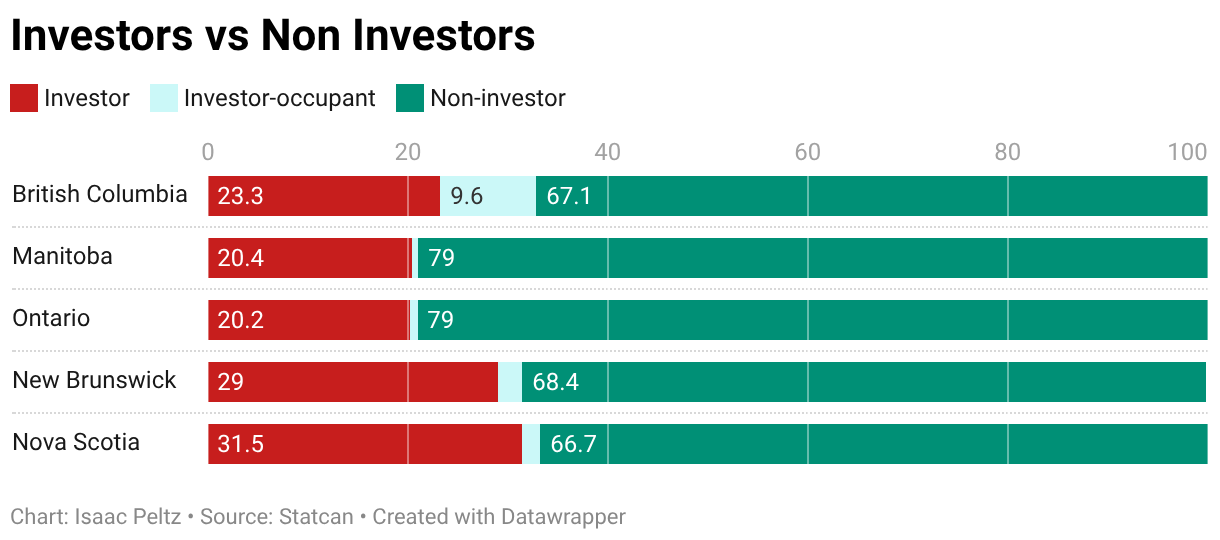
Chart created with Datawrapper by Isaac Peltz using data from Statistics Canada. Data from 2020.
The trend line is getting worse on financial landlords. Some might view rental income as the only way to supplement the rising cost of home ownership and some may be taken in by the promises of financialization. Whatever the reason, people buying houses solely for their own use are dropping. Around 67 per cent of Canadians own a house, but ownership is becoming weighted in favour of older people – Gen X and older own houses, but fewer and fewer millennials and younger own housing.
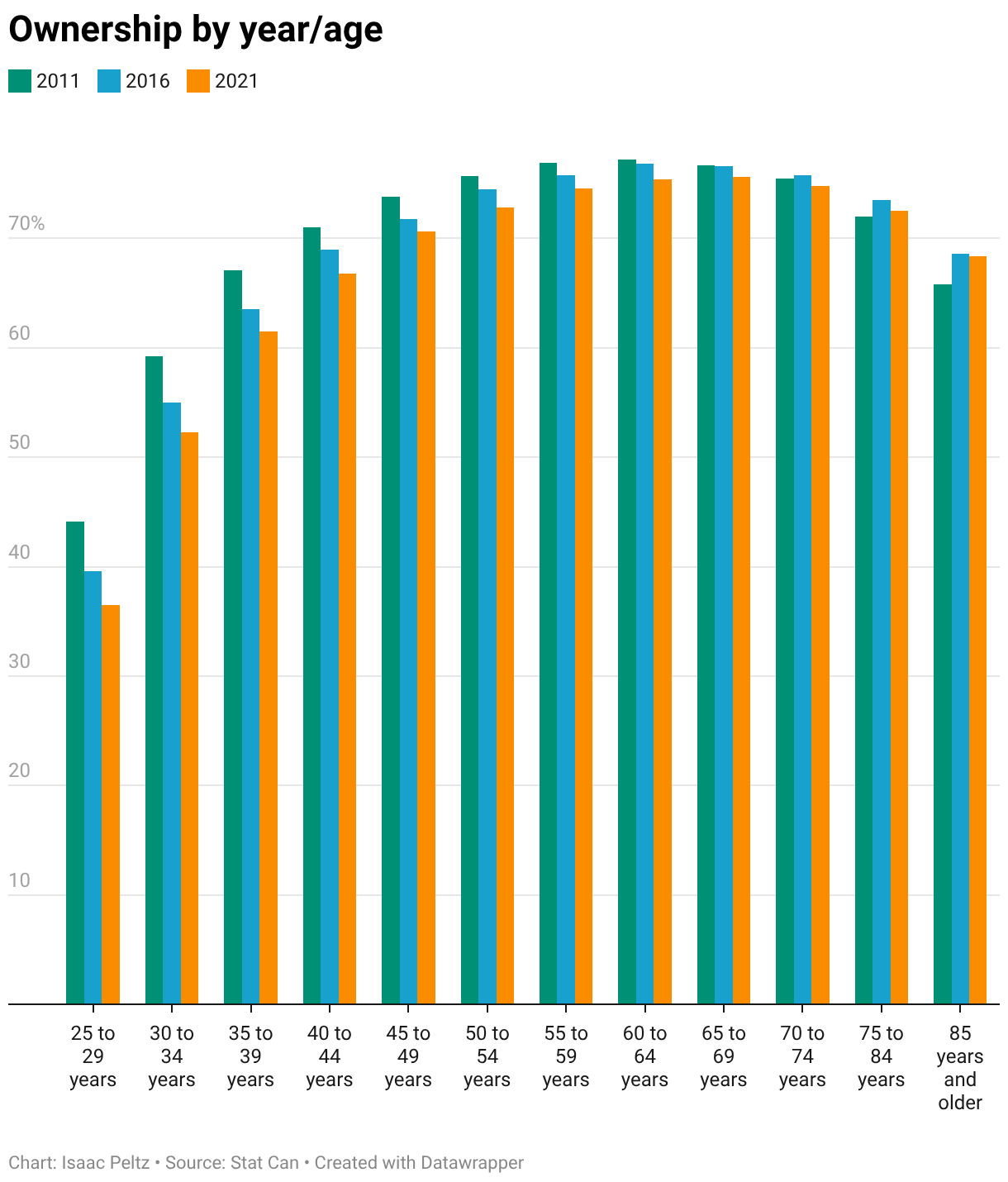
Chart created with Datawrapper by Isaac Peltz using data from Statistics Canada.
Non-institutional landlords are often interested in maximizing their investments. They throw up drywall and turn a house into a five-unit building with cheap materials, leading to housing in complete disrepair, making them illegal units. An average of one in 14 of all housing units across the provinces are in need of major repairs, and one quarter are in need of minor repairs. In 2022, 494,600 rental units in provinces across Canada were “not suitable” for living, with 462,300 in need of major repairs.
The nature of non-institutional investor landlords or “mom-and-pop” landlords means that they face significantly less scrutiny from the government than corporations. It is commonplace in most provinces to see “illegal units,” also known as unregistered secondary units. Apartments, basement suites, etc. will be put up for rent without government registration. Statistics around the number of secondary units on the market are hard to find, because by definition they are avoiding government scrutiny and accountability. In 2021, the Canada Mortgage and Housing Corporation did a study in Ontario which found that an estimated one out of six houses in Toronto had a secondary unit – an estimated 75,000 units in the city.
Bulwarks against regulation
“Mom-and-pop” investor landlords are a creation of the financialized housing industry, and are a bulwark to push back against government regulation. They operate as a hegemonic shield, utilized by highly capitalized corporate landlords, Real estate investment trusts (REITs), and aggressive industry lobbying groups to obscure the rapid and systemic financialization of Canada's housing stock. REITs are companies that own and operate real estate for the purpose of making money.
Small-time landlords have teamed up with corporate landlords and REITs to form pseudo-unions that create a narrative in mainstream discussion to further propagate the myth of “mom and pop” landlords.
Landlord groups such as Rental Housing Canada, Federation of Rental-housing Providers of Ontario, LandlordBC, Corporation des propriétaires immobiliers du Québec, Alberta Residential Landlord Association, and Calgary Residential Rental Association are controlled by corporate power, but since a few members are small-time “amateur” landlords, they use the reputation of the few to push for laws that benefit corporate monopolies. Industry actors shape public perception and discussion through highly successful media campaigns.
Danielle Kerrigan, a post-doctoral fellow in Simon Fraser University’s geography department, examined how Canadian media frames rent control. Analyzing 52 articles from the Toronto Star, Globe and Mail, and National Post, she found that the “five most common arguments presented were: (1) it hinders supply (77 per cent); (2) it protects tenants (31 per cent); (3) it has no impact on supply (23 per cent); (4) it negatively impacts tenants (19 per cent) and; (5) it harms landlords (17 per cent).”
By anchoring the public and legislative debate to the purportedly vulnerable homeowners, the people who are struggling to make ends meet for the sake of their family, the broader real estate industry successfully campaigns against rent control, tenant protections, and anti-speculation taxation, all while consolidating unprecedented volumes of residential property. And they do it openly, unchecked by governments that need housing investment to grow, because after decades of catering to private industry while scaling back social housing, housing represents nearly 10 per cent of Canada’s GDP, not including housing construction or related industries such as finance and insurance.
Montreal has the highest share of renters among large North American cities. The rental market is dominated by REITs and corporate ownership. In 2020, over 30 per cent of Montreal’s market was owned and controlled by 600 companies, despite there being 129,960 residential property owners in the city. In other words, one third of rental units were owned by 0.46 per cent of residential property owners in the city as of 2020.
Real estate investment trusts
The biggest perpetrator of rising rents and centralizing ownership is REITs, which have created algorithmic strategies to target neighbourhoods with early signs of gentrification. There is consistent correlation between more expensive neighbourhoods and REIT concentration. In Montreal, REITs owned at least six per cent of purpose-built rental units from 2015 to 2019, but they are now estimated to own as much as 10 per cent.
These REITs and the investor class of landlords are constantly lobbying governments for GST and HST cuts on rental development and accelerated eviction powers, as well as lobbying that opposes rent control. Governments across the country in 2026 are handing them what they want on a silver platter.
Mark Carney’s federal government, which saw the most lobbying in the lobby registry’s history last October, is offering a 100 per cent GST rebate for new purpose-built rental housing. In March, Ontario announced a massive HST rebate for new homes. Nova Scotia and Newfoundland and Labrador are copying the strategy. B.C. has its own version that has been in place for over a decade – rent in B.C. is still, by far, the highest in Canada.
The corporate landlords seem to have won. By using the myth of the “mom-and-pop” landlord, they have crafted a narrative that dominates the media and have pushed the government to provide corporate welfare to both developers and landlords in an unprecedented way.
The system has been built to benefit only a few: corporate landlords, REITs, and developers. Meanwhile, renters are unable to make ends meet as everything skyrockets in price, from gas, to groceries, to health care, and obviously rent.
Whether we take the “mom-and-pop” landlord myth as a reality, or we acknowledge that this type of landlord is a rare breed whose importance is exaggerated to benefit corporate power, the takeaway remains the same. The system is designed to extract wealth from renters pursuing a basic right to shelter. Instead of confronting this, every government across Canada is leaning into it.
Instead of fixing it, governments everywhere deregulate with no checks to corporate profit.
Mom-and-pop landlords are an endangered species that hardly exist outside our collective imagination. Without a course correction, renters may be left to go extinct as well.
*Alexandria is a pseudonym used for fear of landlord reprisal. First name is used for other private citizens interviewed upon author’s request.

Isaac Peltz is a bilingual freelance investigative journalist based in Montreal. Their in-depth reporting from the national housing crisis and provincial education policy to government ethics has appeared across independent outlets in both English and French.