
Photo courtesy of Caelie Frampton
The class problem at the heart of the housing crisis
By Steve da Silva and Marianne Lau
When People’s Defence (PD) began organizing in Scarborough, Ontario in 2015, the housing crisis was already well underway. Rooted in neighbourhood organizing and class struggle, PD emerged in a context where tenants faced rising rents, deteriorating housing conditions, and unjustified evictions. Meanwhile, homebuyers were taking on ever-greater debt to keep up with inflating real estate prices, while those in public housing faced chronic neglect and other forms of oppression.
While organizing against COVID-19 evictions in 2020, we saw the crisis take another turn. Many working-class families in the tenant unions we helped build took the leap into home ownership as interest rates hit historic lows. But as inflation surged in 2022 and rates rose sharply, many became “house poor” and some eventually faced foreclosure. Today, homebuyers of that era are being squeezed as low-rate mortgages come up for renewal at much higher borrowing costs. The pressure is especially acute in Toronto’s condo market, where falling prices have left some buyers owing more on their mortgages than their homes are worth.
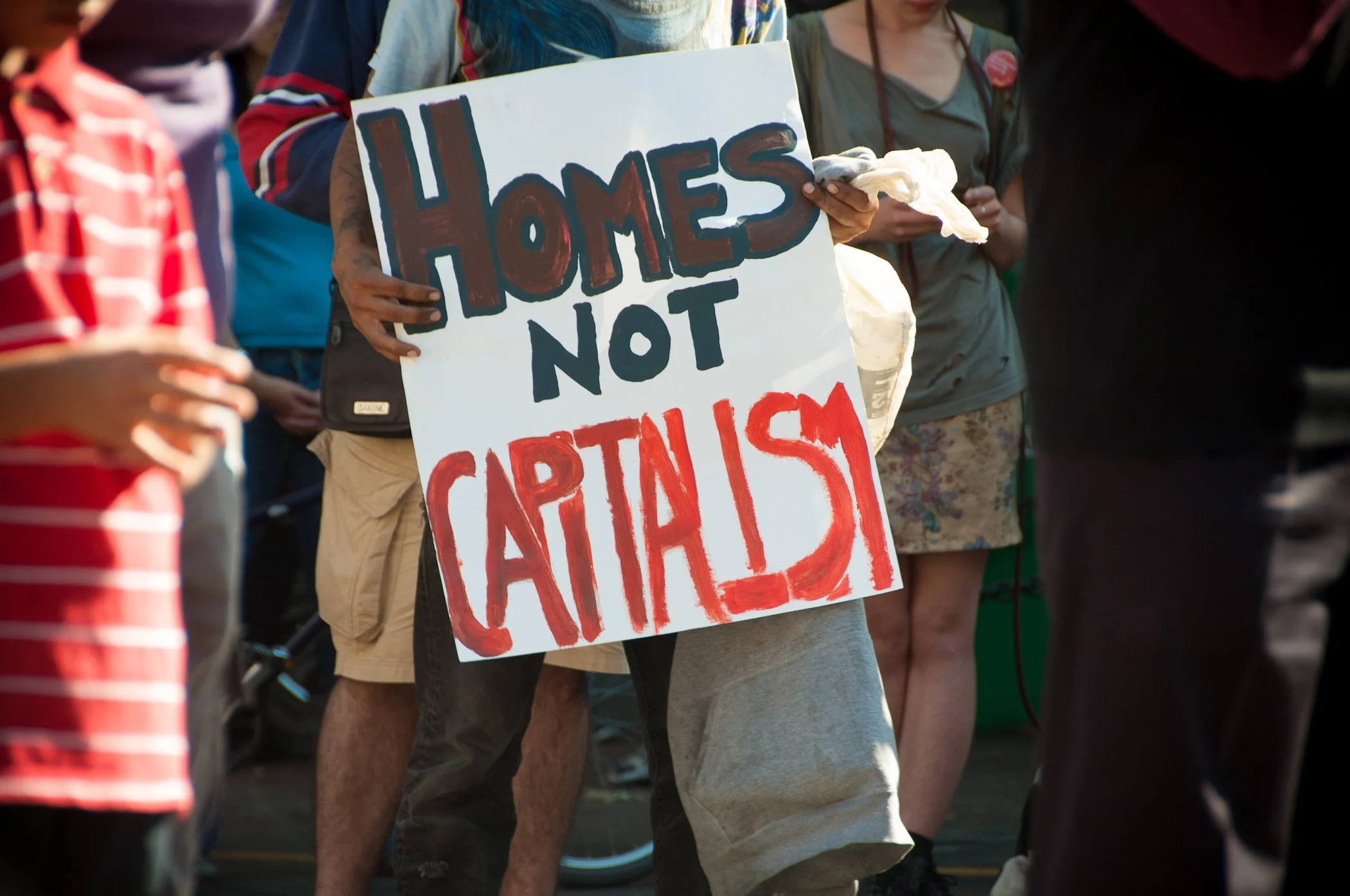
As the housing crisis has intensified, a growing number of renters and mortgage-holders have seen their personal finances squeezed to, or beyond, their limits. This has made the housing crisis more than just a tenant’s problem. We need to understand it not as the result of policy failures or individual bad actors, but as the outcome of a class system that produces these conditions by design.
How did we get here?
Across the political spectrum, policymakers, corporate media, mainstream economists, and housing analysts have suggested that policy failures, greedy landlords, supply constraints, government regulations, and/or immigration are to blame for the housing crisis. The more critical takes focus on the role of financialization in recent decades, but even these analyses are often limited to describing and periodizing policy shifts and the governments responsible for them. Too few trace the roots of the present housing crisis to capitalism itself.
After the Second World War, manufacturing was an engine of economic growth in the U.S. and allied countries like Canada, but by the 1970s industrial profit rates began to decline. Over time, and with other factors at play, capital increasingly shifted into new areas for profit-making. In this context, finance, insurance, real estate (FIRE), and other forms of rent extraction grew to monstrous proportions (alongside broader neoliberal restructuring of the global economy). As of the first quarter of 2026, FIRE accounted for 20 per cent of Canada’s GDP, with manufacturing trailing at eight per cent, and mining, quarrying, and oil and gas extraction – despite Canada’s status as an energy and minerals superpower – at five per cent.
Through this shift, real estate has become a giant speculative sink for capital. This has driven up housing costs globally, saddled people with enormous amounts of debt, and trapped the rest in rental markets with skyrocketing rents.
This is why considering the landlord/tenant relation as a class relation does more to confuse than clarify things. Certainly, there are some differences between a tenant and the working-class family that rents them a part of their home to help cover mortgage payments and other expenses. But both of these parties are beholden in their own way, more or less directly, to finance capital.
Capitalism is driven by the compulsion to extract as much surplus value as possible from waged labour. Workers produce more value in production than they receive in wages, and that surplus is appropriated by the capitalist as profit. Landlords and creditors claim further portions of a workers’ wage (and middle-class salaries) through rent and interest payments. As these claims grow, workers are forced to intensify their labour just to survive. Thus, rising rents and unbearable amounts of debt don’t only keep people shackled to their financiers, but also to exploitation in the labour force. The system as a whole is structured around the continuous expansion of extraction, not just a single mechanism such as rent.
If the problem is structural to capitalism, then the limits of reform become clear. Policies such as rent control or housing subsidies may offer temporary relief for some, but they leave the underlying relations of exploitation intact. We have seen this before. Remember “Fight for $15”? The wage gains of the late 2010s were wiped out by the early 2020s, with the working class left no stronger to fight on the shifting terrain. Working-class gains are consistently recovered elsewhere by capital, producing a cycle of apparent progress amid actual decline.
In view of all this, the task of organizing becomes clear. Tenant struggles must certainly fight for concessions and beat back the constant attacks on renters. But we can’t just defend tenants in isolation from the rest of the system. We must build the struggle with a clear and sober view of the class forces bearing down upon us, and what kind of system we’re going to replace this one with.
For us, this isn’t a theoretical exercise. In August 2025, People’s Defence hosted a conference that brought together neighbourhood and tenant organizers from across Canada to challenge the “localism” holding back our work, and to develop a strategy and the movement to actually confront dominant class forces. Off the Defensive/Offensive populaire was launched to develop the people’s struggle in neighbourhoods and other geographical communities across Canada, while uniting those struggles in a way that can truly overcome the present crises.
As some comrades have put it, it’s time to bring the struggle home.
Steve da Silva and Marianne Lau are among the co-founders of People’s Defence, an organization that has been active in neighbourhood struggles across the Greater Toronto Area for nearly a decade. They are also members of Off the Defensive / Offensive populaire, an organization that aims to unite neighbourhood organizers across Canada to fight for working-class power.