
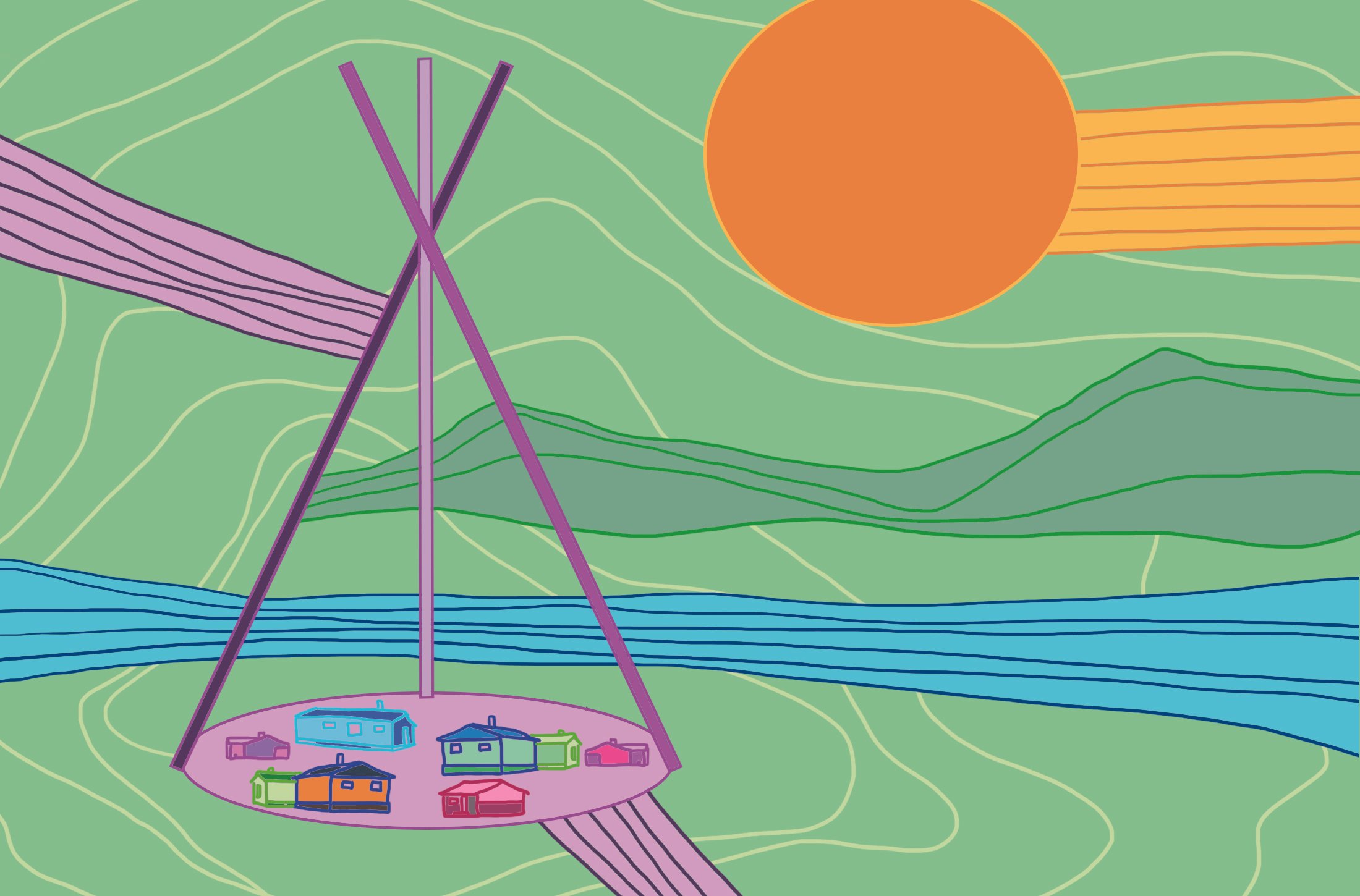
Lianne Marie Leda Charlie
Taking Back the Teepee: Indigenous Housing Policy and Colonization
By Riley Yesno
One racist antagonism that I, and many other Indigenous people, have encountered is the argument: “If it weren’t for settlers, we would all still be living in teepees.” This aggression, more than some others, always puzzled me.
Beyond the fact that we simply don’t know how Indigenous people would have been living if we didn’t have to spend generations focused on survival and adaptation, it ultimately reads as a weak deflection of settler societies’ profound housing shortcomings.
Settlers in this country that we currently call “Canada” have produced a housing environment in which people are experiencing high rates of homelessness and housing precarity. Even more concerningly, these already-dire statistics worsen when you look at the housing conditions of demographics like the elderly, single mothers, immigrants, and, important to this analysis, Indigenous peoples. A 2013 study found one in 15 urban Indigenous people experience homelessness compared to one in 128 of the general population. Results from the 2020–2022 point-in-time counts revealed that 35 per cent of the unhoused population identified as Indigenous despite making up only five per cent of the population.
These conditions could not possibly result from a handful of poor policy decisions or the negligence of any one government. Instead, we consider that these housing conditions are the intended outcome of a centuries-long colonial project aimed at eliminating and replacing Indigenous ways of life – one that began from the earliest days of contact and persists today.
I want to know: how did we, Indigenous people, go from societies with virtually no concept of homelessness to some of the greatest sufferers in this current crisis? And perhaps more importantly, how can we move through it? Maybe the answer lies in the teepee – this frequent site of colonial disparagement can offer us valuable insights into where we went wrong and what we might be able to return to if only we can unlearn the thinking that caused settlers to denigrate it in the first place.
Control over Indigenous social and environmental configuration has long been an explicit objective of the colonial state. Whether it was moving First Nations people to reserves, forcibly relocating Inuit into central hubs, disallowing Métis communal land rights for generations, or more recent data showing that landlords are less likely to rent to Indigenous applicants due to racist stereotypes, “Canada” has proven to be more than proficient at using attacks on living arrangements as a tool to devastate Indigenous life.
And why has Canada poured so much effort into disrupting Indigenous housing? More than just a plot to remove Indigenous people from their territories so that land can be bought and sold by the growing settler populations, the attack on Indigenous mobility, housing, and community infrastructure and incentivization of Indigenous migration to urban centres where we would face increased discrimination allowed colonists to advance an assimilationist agenda with far greater efficacy.
In other words, it’s not just that settlers thought poorly of our housing structures like the teepee and sought to replace them. They knew that by attacking our housing, they could attack more fundamental aspects of our Indigenous ways of being.
As such, when looking for solutions, we should consider this: Indigenous peoples were never meant to live in colonial housing models and adhere to settler conceptions about how to live in a community, whether on reserve or off.
From an Indigenous perspective, why would we try to fix “Canada’s” existing housing models, which have never been meant to serve us? Instead, perhaps, we should work at articulating what truly revolutionary Indigenous housing models might look like – a task that could address the housing crisis in this country at its root, and one with which I believe the teepee can aid us.
For decades, Canadians have been told that, when it comes to housing, individual home ownership was the goal – a necessity for a stable and self-sufficient life. As put simply by program director and associate professor of political management Jennifer Robson, referencing the work of political strategist and professor Tom Axworthy, “Canada has, from our very earliest days as a colony and a country, adopted policies intended to increase individual ownership over productive assets.” Given this fundamental emphasis on individual home ownership in Canada, it is unsurprising that, in recent years, the federal government has made public its concerns about a nationwide decline in homeownership among its citizens.
From an Indigenous perspective, the problem with this housing expectation, beyond any other practical considerations, is that individual home ownership and the types of families who are expected to live in that home – single, nuclear families – cater to lifestyle conditions that are deeply incongruent with many Indigenous people’s traditional values and community structures.
Where Indigenous nations developed systems of communal living and collective responsibility over housing infrastructure – housing in which multiple families lived intergenerationally and which was designed to readily expand to accommodate new community members – white settler society has bolstered a model that upholds much smaller, segregated forms of living.
In response to this value system, several groups of Indigenous people have developed and supported initiatives that promote communal ownership and collaborative living. One such example is the National Indigenous Collaborative Housing Inc. (NICHI), whose work supports off-reserve Indigenous housing projects that centre those most in need and incorporates Indigenous communal values.
For instance, they helped to secure $2.4 million in funding for the development of an Inuit apartment complex primarily for single mothers, which includes a central daycare so that these mothers can have child care and similar family supports built into their living environment.
There are a growing number of Indigenous-owned and led “community land trusts” (CLTs) being established across the country. CLTs are a model of land tenure meant to respond to land-based needs, which can include and extend beyond housing (securing and stewarding any type of real estate, including residential, commercial, greenspace, and so forth), and are owned by a not-for-profit, membership-based group (Canadian Network of Community Land Trusts (CNCLT). The CNCLT currently recognizes at least 10 different Indigenous-led land trusts in “Canada,” at least half of which are committed to creating affordable, communally owned Indigenous housing.
Moreover, Indigenous peoples across the globe have been trying to establish that it’s not just more housing that is needed, but that we are entitled to specific kinds of housing that better align with our traditional views of the home. For example, “In September 2020, the remote Aboriginal community of Ltyentye Apurte (Santa Teresa) in the central Australian desert won a significant Supreme Court case against the Northern Territory (NT) government, their landlord. The community argued they were entitled to more than ‘safe’ housing – that did not endanger human health – but also ‘humane housing.’” Humane, here, means housing that supports traditional modes of community living, a requirement which scholars have critically pointed out, is guaranteed by the United Nations Declaration on the Rights of Indigenous Peoples (UNDRIP), particularly Article 21 (i) and Article 23, which “Canada” officially adopted into federal law in 2021 and some provinces (British Columbia) in 2019.
Another element of “Canada’s” housing structure that this chapter addresses is how housing has been positioned as a major source of economic production and of individual and intergenerational wealth generation. According to Statistics Canada, the real estate, rental, and leasing industries are among the most prominent contributors to gross domestic product when broken down by sector. In short, “Canada’s” economic prosperity is inextricable from “Canada’s” housing industry.
By comparison, research with Australian Indigenous peoples shows that “many Indigenous households are more concerned with issues of stability, inheritability and autonomy than with wealth creation through home ownership, suggesting that models based on expectations of wealth creation and asset building might not align with household or community objectives.” Again, this assertion circles back to the point that housing, from many Indigenous perspectives, is not meant to be looked at as an asset but rather a right – or, more accurately, a responsibility that all members of the community are expected to uphold. Indeed, to this point, Wet’suwet’en Hereditary Chief Mel Bazil teaches that the dominating rights-centric discourse that is often used, even in progressive circles, is rooted in an individualist mindset, one which ultimately places the onus on individuals to assert and defend their rights, rather than on the collective to ensure these standards of living are upheld.
Today, Indigenous peoples are countering the idea of housing-as-wealth through various means, including advancing the “rights to nature” movement, which seeks legal protections for lands and waters under the premise that nature is a living entity and thus cannot be individually owned or profited from. Instead, they can, at best, be publicly “owned” and communally stewarded in perpetuity. There are also numerous movements of Indigenous people re-occupying so-called “Crown Lands”. In doing so, Indigenous people are countering narratives that some lands are for “preservation” rather than human habitation – a narrative that has long existed, Indigenous people and scholars argue, to justify state control over massive swaths of land to maintain geographic and economic dominance rather than structure the lands for the betterment of communities. While not directly addressing housing, this example demonstrates how Indigenous people are challenging the notion of land as an asset at its very root – whether owned by an individual, a corporation, or a state.
The current housing model is becoming financially and practically unsustainable. While we search for solutions, we should challenge ourselves to envision truly anti-colonial models of housing in this country. As Indigenous people intimately know, the very foundations of this country’s housing models are based on colonial ideals of exploitation, individualism, and hierarchical control.
As such, a primary call of Indigenous housing advocates is not to be treated equally in the housing sector, but to be empowered to develop our own culturally informed housing practices.
Indigenous housing revolutions might not mean literally returning to living in teepees, but they do, in many ways, mean returning to teepee ethics. These ethics show us that housing is not an individual right but a collective responsibility for entire communities to uphold, and it must centre on sustainability and adaptability, making way not just for a transformed view of places to live, but also for ways of living.
Ultimately, this is what taking back the teepee might look like. The next time someone tells me we’d be living in teepees if it weren’t for colonization, I can confidently respond with, “I hope one day, I will again.”
This article is an adapted version of the chapter Taking Back the Teepee: Indigenous Housing Policy and Colonization in the upcoming book Housing Canada: Perspectives Across Provinces and Territories, published by University of Toronto Press.

Riley Yesno (she/her) is a queer Anishinaabe researcher, commentator, and writer from Eabametoong First Nation and Thunder Bay. She is currentlycompleting her PhD in political science and writing her first book. She is a regular instructor in Toronto and a distinguished fellow with the Yellowhead Institute.