
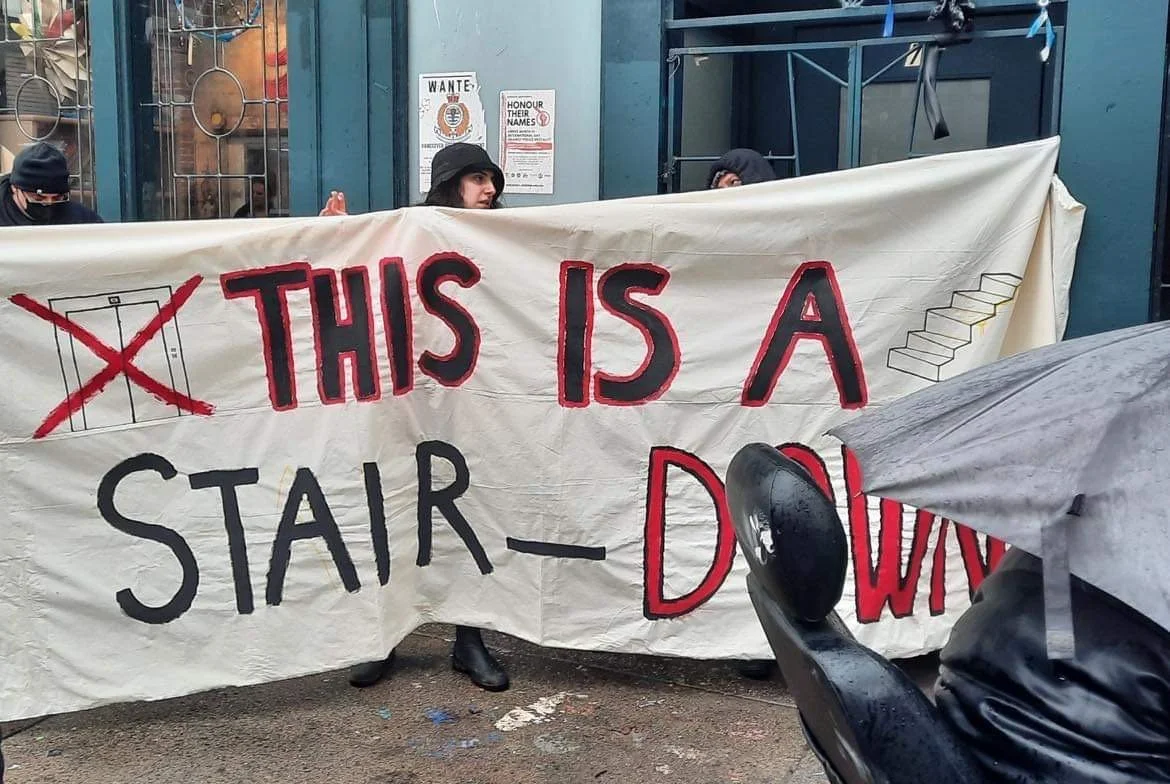
Tenants at the supportive housing building managed by non-profit landlord PHS Community Services Society form the Portland Tenants Union (PTU) in 2023 and rally against a broken elevator severely impacting tenants with mobility disabilities which led to multiple deaths. Photo by A.J. Withers; submitted by Vancouver Tenants Union (VTU).
When support is carceral
Rather than alleviate the crisis, government-provided housing reproduces carceral conditions which violate tenant rights
By Cailin Tyrrell
In response to the growing rental crisis, the B.C. government has increased its reliance on non-profit landlords to provide housing, rather than developing publicly owned and operated housing. The result has been not only a rise in private landlording but also increased funding of non-profits to operate supportive housing. These non-profit landlords have become a shield for government responsibility to actualize the right to dignified and adequate housing.
Much advocacy these days calls for an increase in social housing – below-market subsidized housing – as a solution to the housing crisis. When faced with the reality that 94.5 per cent of all housing in Canada is private market housing, with community, co-op, and non-profit housing making up only 5.5 per cent of the housing supply, this solution seems to make sense.
But B.C.’s supportive housing system – below-market housing combined with other supports – is a warning for how quickly a house can become a prison when tenants are excluded from decisions, housing providers are not regulated, and housing is divorced from other social issues and the design of the housing system as a whole.
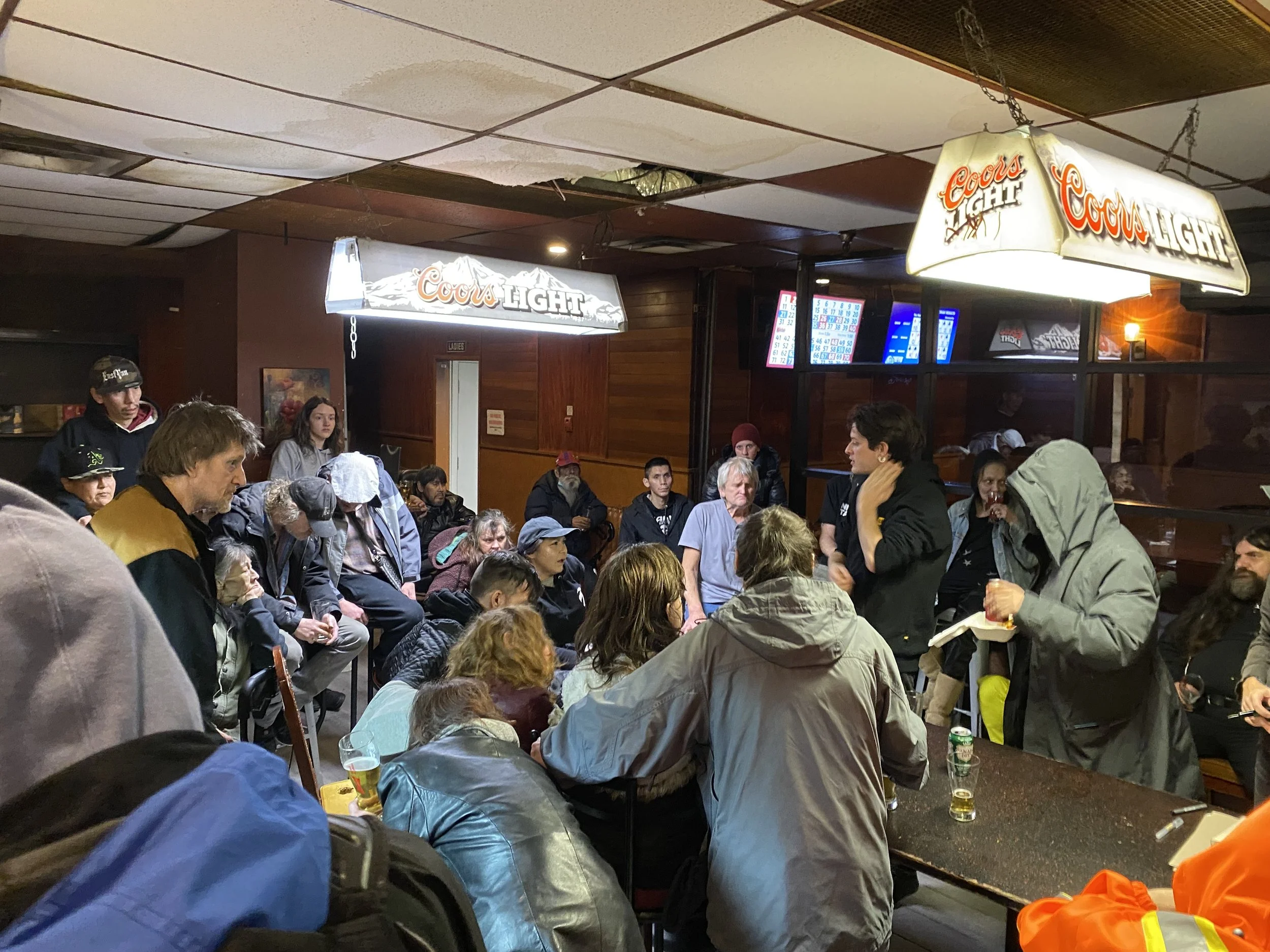
Tenants of what would become PTU gathered on January 25, 2023 to discuss the horrific conditions in their building. Submitted by VTU
Carceral conditions
Funding for supportive housing was never adequate to provide safe, appropriate housing to all those in need across the province in a way that fully respected their tenancy rights. But in recent years, a lack of funding has contributed to worsening conditions inside supportive housing buildings, leaving tenants in increasingly deplorable conditions. With virtually no other housing options, tenants are often forced to remain in buildings with rampant pest problems, crumbling infrastructure, and unmet repairs – all with little oversight, ensuring these problems are never dealt with.
The result is an outgrowth of carceral housing in which non-profit landlords operate buildings in ways that are oppressive to their tenants. Doing so violates the legal rights of tenants in supportive housing that entitle them to basic things: the right to have guests under reasonable circumstances, to not have their landlord barge into their unit without giving proper notice, and to not lose their home without due legal process.
The B.C. government has begun to roll back fundamental rights that would protect tenants from these inhumane conditions. Non-profit landlords are at the forefront of these changes, regularly lobbying the province to ensure that any reforms of the Residential Tenancy Act (RTA) align with their own interests.
The non-profit industrial complex
The BC Coalition for Safe and Sustainable Supportive Housing was formed in 2024 and includes representatives from approximately 20 non-profits. Mainstream media consistently refers to organizations operating under the BC Non-Profit Housing Association as housing providers rather than landlords, positioning this non-profit industry as a public good despite the cracks in its facade of benevolence. Relationships centred around rent extraction undergo a moral transformation which obscures the power imbalance between non-profit landlords and the people they are supposed to support.
To justify infringements on tenants’ rights, these landlords demonize and blame tenants and the few rights they have, which drives moral panic about the very people they are tasked with supporting. This seemingly two-faced strategy undermines their entire stated purpose. As the late Flora Munroe, a member of Our Homes Can’t Wait and Vancouver Area Network of Drug Users, said to The Mainlander in 2023, “How do you expect people to take a step ahead, to get ahead in their lives, when all you’re doing is telling them you can’t do this, you can’t do that?
The Surrey Union of Drug Users outlined a thorough holistic approach to securing safety for everyone in the supportive housing system: involve past or current users of unregulated substances who’ve been in supportive housing in policy; create service standards and training requirements for housing providers; stop the exploitation of workers; require peer-led support and empower tenants through de-escalation roles; build in regular community consultation; expand harm reduction initiatives; and regulate the toxic drug supply.
Rather than holding non-profit landlords accountable for providing housing that meaningfully addresses the complex needs of tenants in supportive housing, the provincial government enacts the legislative changes that landlords ask for, treating tenants’ lives as an afterthought.
Violating tenancy rights
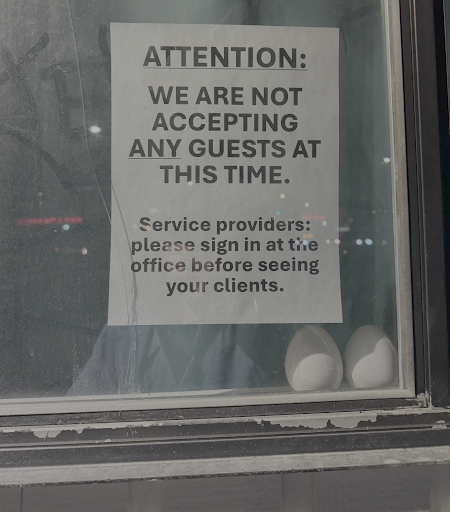
Photo taken at the entrance of a supportive housing building in Prince George, B.C.
In 2024, the BC NDP government moved to reduce tenant protections in supportive housing by amending the Residential Tenancy Regulation through an Order in Council – a tool that empowers individual ministers to make reforms without legislative oversight. With the stroke of a pen, tenants in supportive housing officially lost a number of core tenancy rights that tenants in private market rentals still have: the right to have guests, restrictions on landlord entry, and their right to “quiet enjoyment,” which encompasses the right to exclusive use and occupation of their home.
Reports of safety and security threats in supportive housing coming from landlords themselves are once again driving the narrative that axing the few tenancy rights that are left in supportive housing will solve the problems of a rental housing system that is built on evicting people to death.
Most recently, non-profit landlords have been lobbying the provincial government to restrict tenancy rights under the guise of improving safety conditions for workers. While worker safety is a significant concern – one that can be adequately addressed through proper training, wage increases, and systemic protection – throwing tenants under the bus by calling them violent or unruly ignores the role that non-profits play in creating the unsafe conditions endured by workers and tenants alike.
Non-profit landlords are also blaming tenants for a lack of suitable safe-using spaces and proper ventilation within their buildings. In some cases, these landlords have jumped on harmful rhetoric around the dangers of second-hand fentanyl smoke in the name of “worker safety,” rather than ensuring access to spaces for safe use and addressing structural air quality concerns. This kind of blame pushes some tenants to use out of view, despite the increasingly toxic local drug supply.
In March, the BC NDP passed Bill 11, or The Residential Tenancy Amendment Act, following a consultation period that lacked meaningful engagement with the tenants most impacted by the amendments. Bill 11 carries serious consequences for all tenants in supportive housing buildings, particularly those living in rural or remote areas who already face barriers to accessing increasingly depleted resources.
Under the bill, tenants can be immediately evicted for carrying weapons. “Weapons” is not defined in Bill 11, and could mean anything from a screwdriver to a pair of scissors.
Tenants are not afforded any type of mediation or arbitration process before being kicked out of their home. Tenants also risk eviction for any suspected weapons brought into the building by their guests. Landlords are able to apply this measure with impunity and only ask questions should the tenant dispute the eviction.
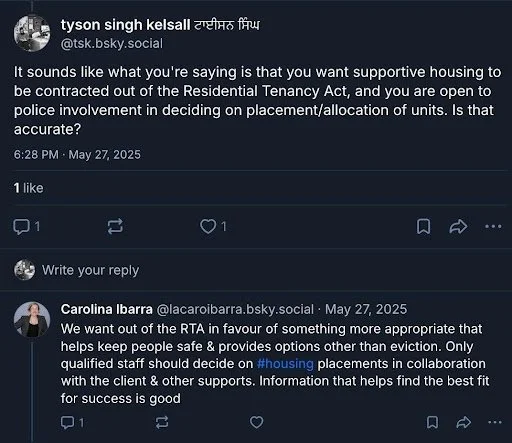
Screenshot taken from Bluesky capturing interaction between CEO of Pacifica Housing and community organizer Tyson Singh Kelsall.
There is no reason for this ambiguous new rule about weapons, as Matt T. of block stewardship group Our Streets points out in a press release: “It’s [already] illegal to attack someone with a weapon, whether on the street or in your own apartment building. But they are using this idea of weapons as an excuse to roll back the Residential Tenancy Act? It makes no sense.”
Tenant advocates have also sounded the alarm about how this legislation amplifies the potential for gendered violence. Heightened surveillance, guest restrictions, and strict rules all increase women and gender diverse tenants’ vulnerability to gender-based violence. Survivors of gender-based violence are at heightened risk of coercion, threats, and housing precarity.
The difficulty of leaving is exacerbated by the dire housing landscape. If new housing is acquired, the possibility of eviction because of the actions of their abusers or even just guests leaves them vulnerable in a system that should be designed to help them.
Limiting tenant rights and adding layers of coercive control mirrors broader gendered power relations, all while re- affirming the violent colonial conditions that force people into poverty to begin with. As people increasingly become inmates rather than tenants, a second-class citizenship is created that further marginalizes vulnerable populations.
At a time when people are struggling to make ends meet, donations are drying up, and funding is being cut, non-profit landlords waging public relations campaigns against the very people they claim to care about does nothing but undercut the intended purpose of these housing models, accelerating people toward death.
Across Canada, dignified housing for all tenants remains an elusive goal. Current models of supportive housing mean tenants must gamble for their survival. To keep housing from becoming another tool to imprison the most vulnerable members of society, what’s needed are community-led housing initiatives that work for the tenants who need it most.

Cailin Tyrrell (she/her) is a community organizer, social planner, and ex-political staffer working on the front line of the rental housing crisis. Raised in a remote community and coming from generations of working-class trade unionists, she is deeply committed to building a better world.